Raising an Expat Child: The Education Guide Nobody Gave You | Alifiya Noor
Investigating Interesting Minds · Gulf Series — Anwesha Bose in conversation with Alifiya Noor, co-founder of Alhira Global Institute There is a particular kind of anxiety that descends on a family the moment they land in a new country. The adults have chosen this. The child has not. And somewhere b
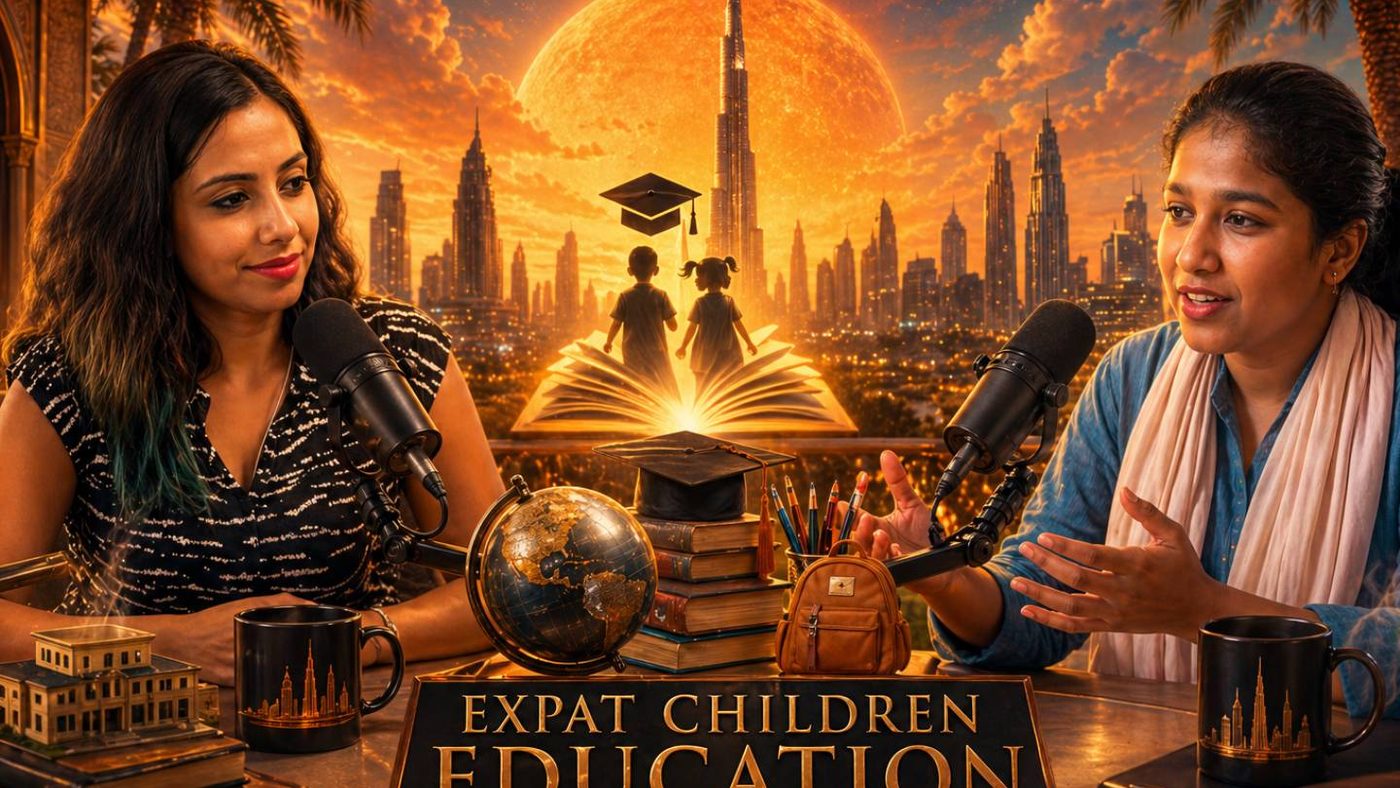
Investigating Interesting Minds · Gulf Series — Anwesha Bose in conversation with Alifiya Noor, co-founder of Alhira Global Institute
There is a particular kind of anxiety that descends on a family the moment they land in a new country. The adults have chosen this. The child has not. And somewhere between the new apartment, the new commute, and the new school uniform, the question nobody has a clean answer for surfaces: is my child going to be okay?
Alifiya Noor has spent the better part of a decade sitting with that question. Together with her sister Arifa, she built Al Hira Coaching Institute, supporting students in British and Indian curricula for ten years. More recently she has launched Al Hira Global Institute, focused specifically on expat families managing the transition of changing countries mid-childhood.
She is in her twenties. She has worked with over 500 students. In a conversation with Anwesha Bose on Investigating Interesting Minds, she says the things parents need to hear but rarely do — without flinching, without jargon, with the occasional story that will stay with you.
You can watch the full episode on Youtube or Spotify
DUBAI BY THE NUMBERS
The city your child just moved to
227
private schools offering 17 different curricula
37%
of students in the British curriculum — ~144,000 children
90%
of Dubai’s population are expatriates
HOW IT STARTED
A side hustle that became a calling
Alifiya does not dress up the origins of Al Hira.
“We started it in 2016 as a side hustle. We were in our late teens. Teenage requirements, pocket money needs — we wanted to be independent.” She had just graduated high school as a state topper. The ambition, initially, was modest.
What changed the trajectory was not strategy — it was watching students change.
Parents began returning to tell them their child was now confident, participating in Olympiads, asking questions in class where before they had barely spoken.
“When parents tell us their child feels more confident now — that is when we said: this is the work. Let’s do it.“
— Alifiya Noor
Today, Alhira supports students aged 6–16 in Maths and Science across Cambridge, Pearson Edexcel, American, IB, and Indian boards.
Classes are capped at five students. Always. “Our goal is not just to teach — it is to empower.”
THE REAL PROBLEM
3 things that derail a child when families move countries
Anwesha asks Alifiya to name precisely what goes wrong with a family moves to a new countries.
What are the specific problems expat children face in their education?
01 — Language shift
“In their home country they are comfortable learning in their language. In a new country, suddenly that changes.” She cites students moving to Belgium where school is taught in Dutch. The barrier hits not just communication — but how concepts are absorbed and how quickly a child feels they belong.
02 — Learning style
Some systems reward conceptual depth and annual exams. Others run weekly tests and prize speed of application. A child who was genuinely thriving can suddenly appear to be struggling — not because their ability has changed, but because the rules have.
03 — Cultural shock
“For a curious student, a new culture is an addition to their personality. But for a reserved child, it shakes their confidence — and that shows up in their grades.” This one, she says, is the most underestimated of the three.
THE BIG PARENT QUESTION
Should you switch curricula when you move?
It is one of the most loaded decisions a relocating family faces. Alifiya’s answer hinges on a single question: what are your plans?
Returning home eventually?
Stay with your home curriculum. University admissions and entrance exams back home are built around it.
Building a life abroad?
Go British (IGCSE) or IB. Designed for internationally mobile students heading to university anywhere in the world.
She draws a useful distinction: GCSE is for UK-based students; IGCSE is the international version — more liberal, better suited to students who may start something of their own.
ON PATIENCE
How long is normal — and when should you worry?
Anwesha asked “What is the timeline at which a parent should expect a child to have adapted to a new education system? And if they don’t do by that time, they should worry.”
Alifiya does not give a neat number. For younger children — six and seven-year-olds who haven’t built deep roots yet — adaptation comes quickly. But for older students in years 8 and 9, the process is harder. They’ve left friends, trusted teachers, a school where they knew exactly how things worked.
“Do not compare them with other students. This heavily impacts their self-confidence. Instead say: you have come this far. You can go beyond this too.“
— Alifiya Noor, to parents
ALIFIYA’S RULE OF THUMB
Look at your child’s progress from day one. Even a 2–3% improvement in four weeks means they are doing it. If after a full semester they are still not finding their footing — that is when to seek support.
INSIDE THE CLASSROOM
Why five students is not a compromise — it is the point
At Al Hira, no batch exceeds five students. In an era when online education prizes scale, this is a deliberate choice.
“When the size is small, you are able to know the gap in their foundational learning. You are able to fix it better.” She also raises something overlooked in large classrooms: the silence of the confused. “Some students feel shy to ask questions in a group of 30 to 40. They think: what if I am wrong? What if I am being judged? So they don’t ask — and the teacher assumes they understood.”
In a group of five, that silence has nowhere to hide. And the scoring philosophy matches: healthy competition is built in, but public ranking of marks is not. “We applaud for every student — so that everybody feels: in my potential, I reached here.”
THE AI QUESTION
The chatbot doing your child’s homework
Anwesha raises the obvious tension: if AI can write the essay, solve the equation, answer the question — why is a child still learning to do those things?
Alifiya reaches for something Jensen Huang, CEO of Nvidia, once said: AI will not take the job of people, but people who are good with AI will take the job of others.
“To be good with AI tomorrow, you need to learn the foundations today. Where do we apply trigonometry? In building bridges. In high-rise structures. Tomorrow there will be more advanced systems — and to build them, the education that is relevant has to be developed today.”
“AI, if used carefully, is a game changer. But students are not using it carefully. Even parents do it — they ask AI for the solution and pass it to the child to finish the homework. That shortcut feels good at the time. The cost shows up on exam day.“
— Alifiya Noor
Her solution at Al Hira Global Institute is structural.
Work happens in the session, in front of the teacher, not at home. “Our job is to reduce the burden on students, not add to it.” The AI shortcut simply isn’t available during learning time — so the gaps become visible, and fixable.
THE PRESSURE NOBODY NAMES
Where Alifiya is building — and what she asks of parents
Al Hira Global Institute is currently focused on the GCC, with years 7 and 9 as a priority — the critical foundation years before GCSE and IGCSE.
After a period of significant disruption to school schedules across the region, Alifiya is direct: “If there is a gap in these classes, students will suffer later.”
>> You can contact Al Hira Global Institute here
For parents watching their child settle — or not — into a new school, her message is consistent: give them time, compare them only to themselves.
ABOUT THE PODCAST
Investigating Interesting Minds with Anwesha Bose
A podcast for anyone who has ever met someone and thought: how did they get here? Each episode is a deep conversation with someone who has genuinely done something with their life — a leader, a founder, an artist, an expert, or simply someone who made an unconventional choice and saw it through. The Gulf Series spotlights people living in or making an impact across the region. Available wherever you watch or listen to podcasts.
Here is the full episode




Social media, comparison, and the 13-year-old who wanted to quit
Near the end of the conversation, the topic shifts — and this may be the most resonant part for any parent in the Gulf today. Alifiya talks about the ambient pressure of visibility: the feed full of teenage entrepreneurs, young millionaires, overnight success stories that children take as a benchmark for their own lives.
“Our students say: ma’am, I saw this on social media. They don’t study and they are making money. They have their own cars. I’ll start making YouTube videos.”
THE MOMENT IN THIS EPISODE YOU WILL NOT FORGET
A 13-year-old tells Alifiya he wants to quit studying and make videos — because he saw someone online who “doesn’t study and already has a car and a house.” She doesn’t argue. She doesn’t lecture. She asks him to look more carefully at what he’s actually seeing, and what the image leaves out. It is a two-minute exchange that says more about raising children in the Gulf today than most parenting books manage in a chapter.
WHAT’S NEXT