Dubai Air Taxi: Crown Prince Greenlights DXB Vertiport – All About The Aircraft, The Deal, & What Next
This Story in Bullets A four-storey building near Dubai International Airport quietly became ground zero for a transport revolution this week. Sheikh Hamdan toured it on 16 April 2026 and declared it ready. By year-end, you will be able to hail an electric flying taxi from this very spot. This story

This Story in Bullets
- Dubai’s Crown Prince Sheikh Hamdan toured and officially declared the world’s first purpose-built air taxi station complete on 16 April 2026, directing that commercial service opens to the public before the end of this year.
- The station sits next to Dubai International Airport, spans 3,100 square metres across four floors, and handles up to 170,000 passengers per year — with two take-off and landing pads and dedicated electric charging infrastructure on site.
- The aircraft is the Joby S4, an electric vertical take-off and landing vehicle that carries one pilot and up to four passengers, flies at up to 200 mph, produces zero emissions, and is significantly quieter than a helicopter.
- California-based Joby Aviation holds a six-year exclusive deal with Dubai’s Roads and Transport Authority to operate all air taxi services within Dubai, with UK firm Skyports Infrastructure building and running the stations.
- The flagship route runs from Dubai International Airport to Palm Jumeirah in roughly 10–12 minutes — a journey that takes around 45 minutes by car — with three further stations at Downtown Dubai, Palm Jumeirah, and Dubai Marina completing the network by end of 2026.
- Confirmed fares are not yet published, though analyst estimates place the DXB–Palm Jumeirah route at around AED 350–650, considerably cheaper than a helicopter charter on the same route.
- Before the first paying passenger boards, Joby still needs its UAE air operator certificate from the GCAA, followed by a phase of non-revenue proving flights — both targeted for completion within 2026.
- Dubai is the first city on earth to turn eVTOL infrastructure into commercial reality, and its launch serves as the global proof-of-concept that the entire air taxi industry is waiting for.
A four-storey building near Dubai International Airport quietly became ground zero for a transport revolution this week.
Sheikh Hamdan toured it on 16 April 2026 and declared it ready.
By year-end, you will be able to hail an electric flying taxi from this very spot.
This story answers
- What just happened — and why the Crown Prince’s visit matters
- What an air taxi actually is, and how it works
- Who is behind this project and how the deal came together
- Where the stations are, what routes run, and how long journeys take
- When commercial flights start — and what they will cost
- What still stands between today and your first flight
Dubai Crown Prince’s Visit To Air Taxi Station
On Thursday 16 April 2026, Sheikh Hamdan bin Mohammed bin Rashid Al Maktoum — Crown Prince of Dubai, Deputy Prime Minister, and Chairman of the Executive Council — toured the emirate’s first purpose-built air taxi station, located beside Dubai International Airport.
The visit was timed deliberately: the following day was the first ever World Public Transport Day.
Accordingly, he did not arrive as a spectator. He directed that commercial air taxi service launches for public use before the end of 2026.
All About The DXB Vertiport
3,100 m²
Total floor area across four storeys
2
Take-off and landing pads on-site
170,000
Passengers the station handles per year
4
Stations planned across Dubai total
The facility, officially called the DXB Vertiport (a vertiport is a dedicated terminal for vertical take-off and landing aircraft), is the first of its kind globally.
Alongside the two landing pads, it carries dedicated electric charging infrastructure for the aircraft, climate-controlled passenger lounges, and a two-level car park.
Mattar Al Tayer, Director General of Dubai’s Roads and Transport Authority (RTA), called it “a strategic addition to Dubai’s mobility ecosystem.”
That phrase carries weight: this station connects directly into the city’s wider transport grid, including metro access and electric scooter bays.
““We are moving forward in translating vision into practical reality, further strengthening Dubai’s position as a global testbed for innovation.” — Sheikh Hamdan bin Mohammed, Crown Prince of Dubai”
So — what exactly is an air taxi?
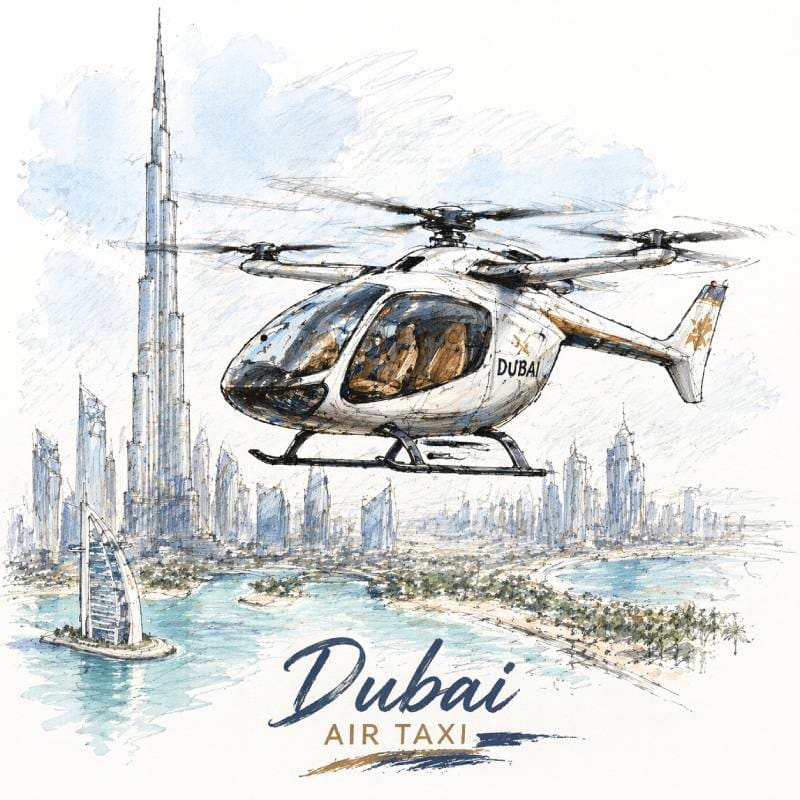
Think of an air taxi as the offspring of a helicopter and a small aeroplane.
- It is quieter than either,
- Electrically powered,
- And built for short city hops.
The technical term is eVTOL: electric Vertical Take-Off and Landing aircraft.
Unlike a helicopter, it does not rely on a single large rotor.
Instead, it uses multiple smaller propellers — six in the case of Dubai’s chosen aircraft — that tilt between two positions: vertical for take-off and landing, horizontal for forward cruise flight.
This tilting mechanism is what lets it behave like a helicopter near the ground and like a small plane in the air.
How it differs from a helicopter
- Six tilting propellers, not one main rotor
- Electric motors — zero operating emissions
- Significantly quieter in flight
- Lower vibration for passengers
- Top speed: up to 200 mph (320 km/h)
The aircraft specs (Joby S4)
- 1 pilot + up to 4 passengers
- Maximum range: 150 miles
- Six electric motors, four battery packs
- Piloted at launch; autonomy planned later
- FAA-certification track underway in the US
Essentially, the eVTOL is what Uber Elevate dreamed about in 2016 — a clean, quiet urban air shuttle.
Dubai is the city that actually built the infrastructure for it.
Who built this? And how the deal came together
Three organisations form the backbone of Dubai’s air taxi programme.
| Organisation | Role | Based |
|---|---|---|
| Joby Aviation | Aircraft manufacturer and operator. Holds the 6-year exclusive operating agreement with RTA. | Santa Cruz, California |
| Skyports Infrastructure | Designs, builds, and operates the vertiport stations. | London, UK |
| RTA — Roads and Transport Authority | Dubai’s transport regulator. Oversees integration with the wider public network. | Dubai, UAE |
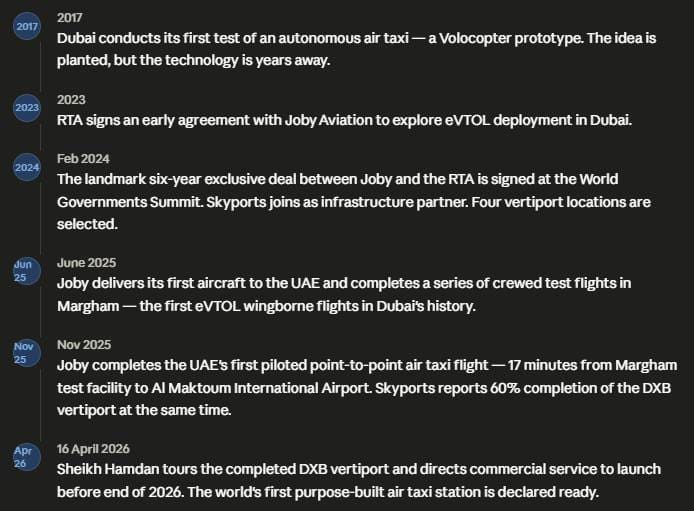
The arrangement traces back to February 2024, when Joby’s founder JoeBen Bevirt signed a definitive deal with the RTA at the World Governments Summit in Dubai, in the presence of Sheikh Mohammed bin Rashid Al Maktoum.
That agreement gives Joby exclusive rights to operate air taxis across Dubai for six years from the commercial launch date.
In short, no rival company runs air taxis within Dubai during that window. For Joby, it is an extraordinary first-mover advantage in one of the world’s most watched cities.
Why Dubai first and not the US?
Joby still awaits full FAA type-certification in the United States.
Dubai’s regulatory environment, governed by the UAE General Civil Aviation Authority (GCAA), allows Joby to use its FAA-validated test data as a foundation for a parallel certification track.
Commercially, Dubai launches first. The US follows once the FAA completes its review.
The journey from a test flight in the desert to a working station
Where can you fly in Dubai in the Air Taxi? And how fast does it get you there?
The DXB station near Dubai International Airport is the first.
Three more follow before the end of 2026, forming the city’s initial network.
| Station | Partner | Status |
|---|---|---|
| Dubai International Airport (DXB) | Skyports / RTA | Complete — ready for service |
| Downtown Dubai | Emaar Properties | Planned — 2026 |
| Palm Jumeirah | Wasl Asset Management | Planned — 2026 |
| Dubai Marina | Atlantis The Royal | Planned — 2026 |
Further stations at the following destinations form the next expansion phase:
- American University of Dubai,
- Atlantis the Royal,
- Dubai Mall
Together, they connect the city’s highest-footfall destinations into a single aerial grid.
On time savings, the numbers are genuinely striking:
Dubai International Airport → Palm Jumeirah
- 10–12 minutes by air taxi
- versus roughly 45 minutes by car in normal traffic.
Dubai Marina → Downtown Dubai
- Projected at under 10 minutes
- versus 30–40 by road.
All routes integrate with ground transport (metro, bus, and electric scooter access) at each station.
What does a ticket cost for Air Taxi in Dubai?
Official fare structures have not been confirmed by the RTA or Joby.
Based on reported estimates for popular routes, the figures below reflect what analysts and early reports indicate — verify before booking when fares go live.
| Route | Flight time | Estimated fare (AED) |
|---|---|---|
| DXB Airport → Palm Jumeirah | ~10 min | AED 350–650 |
| Marina → Downtown | ~8 min | TBC |
For context, a helicopter charter on the same DXB–Palm route runs considerably higher — the eVTOL’s electric propulsion strips out the fuel cost that inflates helicopter pricing.
Booking, when it opens, runs through an RTA/Joby mobile app with dynamic pricing.
What still needs to happen before you board
The station is ready. The aircraft has flown.
Nevertheless, several steps sit between today and the first paying passenger.
- Regulatory sign-off: The UAE’s General Civil Aviation Authority (GCAA) is processing Joby’s air operator certificate — the licence that formally allows it to carry paying passengers. Joby pursues this in parallel with its ongoing FAA certification track in the US.
- Non-paying proving runs: Joby plans a phase of demonstration and non-revenue passenger flights from the completed vertiport before full commercial launch. These stress-test the passenger experience end-to-end.
- Remaining vertiport completions: The three additional stations — Downtown, Palm, Marina — are scheduled for completion during 2026. A full network launch depends on at least some of these being operational.
- Staff and logistics scaling: Ground crew training, emergency response protocols, and maintenance routines at each station are in active preparation.
Why this matters beyond Dubai
Dubai’s air taxi programme is not merely a transport upgrade for a wealthy city. It functions as a live laboratory — the real-world dress rehearsal for Joby’s eventual US commercial launch, and a proof point for the entire eVTOL industry.
For years, sceptics treated urban air mobility as a Silicon Valley fantasy.
Dubai, with a working vertiport, a tested aircraft, and a Crown Prince’s personal endorsement, is answering that scepticism the only way that counts: by building the thing.
Three other cities — Los Angeles, New York, and Riyadh via a separate Saudi Aramco partnership — are watching closely. If Dubai’s launch runs smoothly, the global rollout accelerates. If it stumbles, the setback lands across the whole sector simultaneously.