Qurbani Eid Al Adha 2026: UAE Guide to Meaning, Dua, Prices, Last Day to Cut Hair
Qurbani Eid Al Adha 2026 in UAE — meaning, Eid date (27 May), last day to cut hair (17 May), the Qurbani dua, IACAD prices from AED 350, and the three ways to book in Dubai.
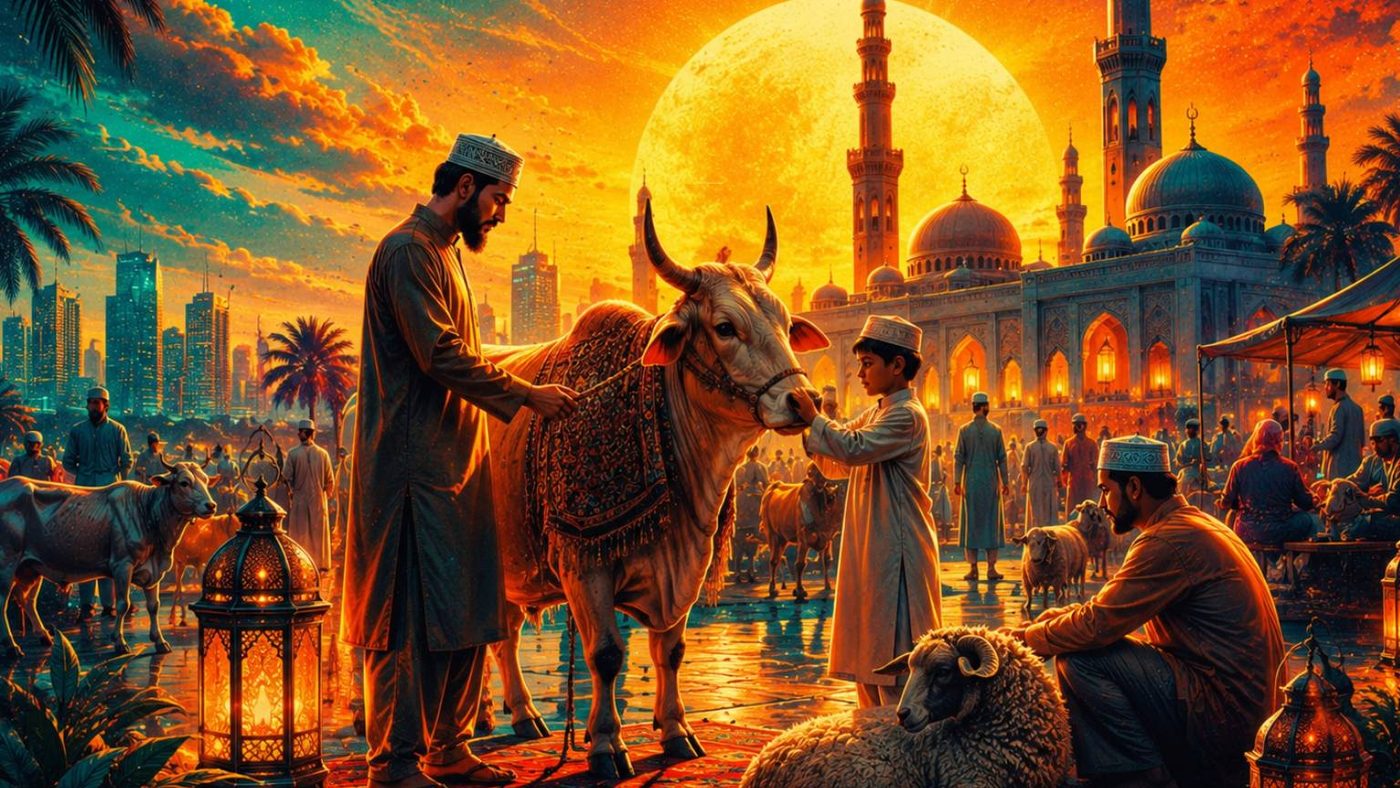
Qurbani Eid Al Adha 2026 in the UAE is the ritual animal sacrifice that Muslims across the country will perform on the morning of Eid. Eid Al Adha 2026 falls on Wednesday, 27 May 2026, confirmed by the UAE Council for Fatwa on 17 May 2026 following the official Dhul Hijjah moon sighting.
“Their meat will not reach Allah, nor will their blood, but what reaches Him is piety from you.” — Surah Al-Hajj 22:37
This guide walks through what Qurbani means, when the sacrifice window opens, the last day to cut your hair, the Qurbani dua, the four IACAD-approved 2026 prices, the three ways UAE residents can fulfil the obligation, and which animals qualify.
Qurbani Eid Al Adha 2026
Here is the at-a-glance view that anchors the rest of this guide — the dates, the window and the starting price.
QURBANI EID AL ADHA 2026 · AT A GLANCE
A small note before we go any further. This guide is our best attempt at putting the religious rules around Qurbani into plain words, drawn from public sources and the guidance of UAE bodies like IACAD. We are not religious scholars or guides — just simple people trying to grow a little closer to the goodness this day brings. If anything below turns out to be off, or if your scholar or family follows it differently, please forgive us and follow them instead.
What is Qurbani? — The Meaning Behind The Act
Qurbani — also called Udhiya in Arabic — is the ritual sacrifice of a sheep, goat, cow or camel that Muslims perform during the days of Eid Al Adha. Crucially, it is the direct re-enactment of one of the most pivotal moments in Islamic faith: the test in which Prophet Ibrahim was commanded to sacrifice his beloved son Ismail.
THE STORY IN ONE SCENE
Father and son both submitted willingly. At the moment of the cut, Allah ransomed Ismail with a great ram — and the command to sacrifice a person was replaced with the command to sacrifice an animal. That ram is the spiritual ancestor of every Qurbani performed today.
The act, then, is not about the meat or the blood. Rather, it is the believer’s annual reminder that everything they hold dear is held on trust from Allah, to be surrendered the moment He commands it.
That three-way split is what makes Qurbani an act of worship and an act of social cohesion in one sweep. In effect, the same animal feeds the household, strengthens the social circle, and lifts up someone who could not otherwise afford meat that week.
When is Eid Al Adha 2026 and when does the Qurbani window open?
Eid Al Adha 2026 falls on Wednesday, 27 May. The UAE Council for Fatwa confirmed the date on 17 May 2026 following the official Dhul Hijjah crescent sighting, aligning with the projections from the Sharjah Academy for Astronomy and the Emirates Astronomical Society.
Need full date and holiday details? Read our complete Eid Al Adha 2026 UAE guide. This article focuses specifically on the Qurbani window and how to fulfil it.
The Qurbani window itself opens immediately after the Eid prayer on the morning of 10 Dhul Hijjah — the 10th day of the final month of the Islamic Hijri calendar. Then, it remains open until just before Maghrib on 13 Dhul Hijjah, covering Eid day plus the three Days of Tashreeq.
What is Tashreeq? The three days following Eid Al Adha — 11, 12 and 13 Dhul Hijjah — are known collectively as the Days of Tashreeq, during which Qurbani remains valid and the Eid Takbir continues to be recited.
THE 4-DAY QURBANI WINDOW
A sacrifice performed before the Eid prayer or after Maghrib on the third day of Tashreeq is not counted as a valid Qurbani. Instead, it is treated as Sadaqah — voluntary charity — and does not fulfil the obligation.
Last day to cut hair for Qurbani 2026
There is a last date because the Sunnah — the practice of the Prophet ﷺ — is for anyone who intends to offer Qurbani to refrain from removing hair, nails or skin once the new moon of Dhul Hijjah is sighted. Symbolically, this aligns the donor with the pilgrims in Makkah, who themselves are forbidden from cutting hair while in Ihram (the sacred state of pilgrimage) until the moment of sacrifice.
THE HADITH
“When the ten days (of Dhul Hijjah) begin, and one of you intends to offer a sacrifice, let him not remove anything from his hair or nails until he has offered the sacrifice.” — Narrated by Umm Salamah (RA), wife of the Prophet ﷺ · Sahih Muslim, one of the two most trusted hadith collections
Specifically, the Sunnah covers anything you might routinely groom or remove. Below is the practical list:
- Hair on the head — haircuts and trims at the salon
- Nails — manicures, pedicures, nail clippers at home
- Beard — trimming, shaping or shaving
- Body hair — waxing, threading, laser sessions
- Skin — peeling or exfoliating treatments that remove skin layers
The math is simple: the Sunnah begins from 1 Dhul Hijjah, which falls 10 days before Eid. With Eid confirmed on Wednesday, 27 May 2026, 1 Dhul Hijjah began on the evening of Sunday, 17 May — making that evening, before Maghrib, the last opportunity to cut hair, nails or skin. If you have not already, the 10-day Sunnah window is already underway.
THE 10-DAY MATH
Who the ruling applies to
How strict is the ruling?
It depends on which madhhab — school of Islamic jurisprudence — the donor follows. The Hanbali school treats it as haram (religiously forbidden), while the Hanafi, Shafi and Maliki schools treat it as makruh (disliked but not sinful).
IF YOU FORGOT
All four schools agree that cutting hair or nails does not invalidate the Qurbani itself. So if you forget, or need a haircut for medical or work reasons, simply seek Allah’s forgiveness and proceed — no expiation, no repeat sacrifice.
Qurbani Dua: What to recite at the moment of sacrifice
Two recitations should be on the lips of the person performing the slaughter. The first is mandatory; the second is the recommended Sunnah.
1. The mandatory minimum: Bismillah, Allahu Akbar
SAID AT THE MOMENT THE KNIFE IS DRAWN
بِسْمِ اللَّهِ، وَاللَّهُ أَكْبَرُ Bismīllāhi, wallāhu akbar In the name of Allah, and Allah is the Greatest.
This phrase is the legal minimum required for the meat of the sacrifice to be considered halal — deliberately omitting it makes the slaughter impermissible. The Quran itself states: “And do not eat of that upon which the Name of Allah has not been mentioned” (Surah Al-An’am 6:121, the sixth chapter of the Qur’an).
2. The full Sunnah dua
RECITED IMMEDIATELY BEFORE THE BISMILLAH
إِنِّي وَجَّهْتُ وَجْهِيَ لِلَّذِي فَطَرَ السَّمَاوَاتِ وَالْأَرْضَ حَنِيفًا وَمَا أَنَا مِنَ الْمُشْرِكِينَ، إِنَّ صَلَاتِي وَنُسُكِي وَمَحْيَايَ وَمَمَاتِي لِلَّهِ رَبِّ الْعَالَمِينَ، لَا شَرِيكَ لَهُ وَبِذَٰلِكَ أُمِرْتُ وَأَنَا مِنَ الْمُسْلِمِينَ، اللَّهُمَّ مِنْكَ وَلَكَ. Innī wajjahtu wajhiya lilladhī faṭara as-samāwāti wal-arḍa ḥanīfan wa mā ana minal-mushrikīn. Inna ṣalātī wa nusukī wa maḥyāya wa mamātī lillāhi rabbil-ʿālamīn. Lā sharīka lahu wa bidhālika umirtu wa ana minal-muslimīn. Allāhumma minka wa laka. “I have turned my face sincerely toward the One who created the heavens and the earth, and I am not among those who associate partners with Him. Truly, my prayer, my sacrifice, my living and my dying are for Allah, Lord of the worlds. He has no partner. So I have been commanded, and I am of those who submit. O Allah, this is from You and for You.”
If the Qurbani is on behalf of someone else, or shared between several donors (as in a cow split between up to seven people), the donor adds at the end: “Allāhumma taqabbal min [name] wa ahli baytihi” — “O Allah, accept it from [name] and his household.”
What to say after the sacrifice
Once the animal has been slaughtered, the donor begins with Alhamdulillah (“all praise is due to Allah”) and may follow with the dua of acceptance. The dua is: “Allāhumma taqabbalhu minnī kamā taqabbalta min ḥabībika Muḥammadin wa khalīlika Ibrāhīma” — “O Allah, accept this from me as You accepted it from Your beloved Muhammad and Your friend Ibrahim.”
EID TAKBIR · RECITED THROUGH THE DAYS OF TASHREEQ
اللَّهُ أَكْبَرُ، اللَّهُ أَكْبَرُ، لَا إِلَهَ إِلَّا اللَّهُ، وَاللَّهُ أَكْبَرُ، اللَّهُ أَكْبَرُ وَلِلَّهِ الْحَمْدُ Allāhu akbar, Allāhu akbar, lā ilāha illa-llāh, wa-llāhu akbar, Allāhu akbar wa lillāhil-ḥamd
3 Ways To Do Qurbani in UAE: Dubai, Abu Dhabi and Other Emirates
Across all seven emirates, the practical framework for performing Qurbani is the same: donate it through a charity, slaughter it personally at a municipal abattoir, or order it through a commercial home-delivery service. However, each emirate has its own regulating authority and its own approved providers, so the names you encounter will differ depending on where you live.
Way 1 — Donate through an approved charity
For donors who want their entire Qurbani delivered to those most in need, the charity route is the simplest path. The charity sources the animal, slaughters it according to Sharia, and distributes the entire carcass to families in the UAE or in a country the donor selects, such as Yemen, Sudan or Somalia.
WHO REGULATES BY EMIRATE
Dubai
IACAD — Islamic Affairs and Charitable Activities Department Abu Dhabi Khalifa Bin Zayed Foundation & Abu Dhabi Awqaf bodies Sharjah Sharjah Department of Islamic Affairs & Sharjah Charity International UAE-wide Emirates Red Crescent (ERC) operates federally across all emirates
Way 2 — Personal sacrifice at a municipal abattoir
For donors who want to keep the meat themselves, every emirate runs municipal abattoirs that operate during the Eid window. Notably, slaughtering animals at home or on a farm is not permitted anywhere in the UAE — the abattoir route is the only legally compliant way to handle a personal Qurbani.
MUNICIPAL ABATTOIRS BY EMIRATE
Dubai
Al Quoz, Al Qusais, Lisaili and Hatta · 8am to 6pm during Eid Abu Dhabi & Al Ain Mussafah and 11 abattoirs across Al Ain, regulated by ADAFSA — the Abu Dhabi Agriculture and Food Safety Authority Sharjah & Northern Each emirate’s municipality runs its own approved facilities
Booking is done through approved smart apps so you do not need to physically visit. The most widely used apps in Dubai are listed below:
- Al Mawashi — operated by the National Food Products Company
- Turki — Sharia-compliant livestock app, popular UAE-wide
- Shabab Al Freej — community-led app with English support
- Dhabayih Aldaar, Al Anoud Slaughters, Dhabayeh UAE, Tender Meat — additional Dubai Municipality-approved options
Way 3 — Commercial home delivery
Commercial Qurbani providers are the convenience-first option. Specifically, three providers dominate the UAE market in 2026:
PRICING NOTE
Commercial Qurbani in 2026 starts at around AED 1,200 for a Somali goat or sheep and runs to AED 6,500+ for a full cow share. Critically, this price covers the donor’s full meat allocation — unlike the charity route where the carcass is donated entirely.
Dubai has approved unified prices of Qurbani for Eid Al Adha 2026
Ahead of every Eid Al Adha, the IACAD — Dubai’s Islamic Affairs and Charitable Activities Department — sets a single price list that all approved Dubai charities must follow. Consequently, donors pay exactly the same per share regardless of which charity they book through, and there is no haggling or shopping around.
IACAD-APPROVED QURBANI PRICES · 2026
AED 350 — Local-abroad
The cheapest tier keeps the entire chain inside the destination country. For example, the charity buys a local sheep in Yemen or Sudan, slaughters it there and distributes the meat there — no transport cost, no logistics, lowest price.
AED 490 — Kenyan or Ethiopian
The middle tier sources the sheep abroad but air-freights the frozen meat back to the UAE. From there, it is distributed to charities, low-income families and labour camps inside the country.
AED 800 — Somali premium
The premium tier imports live livestock to be slaughtered inside the UAE itself. Naturally, live transport is the costliest logistics chain of the four, which is why this price carries the largest premium.
How to book Qurbani online in 4 steps
Approved charities for Qurbani Eid Al Adha 2026 in the UAE
Every charity below operates under direct IACAD oversight in Dubai, or an emirate-level equivalent in Sharjah, Abu Dhabi and the Northern Emirates. While they all apply the same Dubai-set IACAD pricing, they differ in which countries they distribute to and how easy they make the booking process.
| Charity | Emirate | Distribution focus | Booking method |
|---|---|---|---|
| Beit Al Khair Society | Dubai | UAE residents in need + 25 countries | Website, app, branches |
| Dar Al Ber Society | Dubai | Africa, South Asia, Yemen | Website, app, mall kiosks |
| Sharjah Charity International | Sharjah | UAE + 50 countries | Website, branches |
| Khalifa Bin Zayed Foundation | Abu Dhabi | Yemen, Sudan, Africa | Bank transfer, branches |
| Emirates Red Crescent | Federal | Conflict zones + UAE labour camps | Website, app, ATMs |
| Awqaf & Minors Affairs (AMAF) | Dubai | UAE families + abroad | Website, branch counters |
Which animals are eligible for Qurbani for Eid Al Adha 2026 in UAE?
Each species has a minimum age set by Sharia, and a baseline of physical health that disqualifies any animal with serious defects. Notably, only sheep, goat, cow, buffalo and camel qualify — no other species, regardless of size or value, is acceptable.
| Animal | Minimum age | Donors per animal |
|---|---|---|
| Sheep / lamb | 6 months (if it appears one year old) | 1 |
| Goat | 1 year | 1 |
| Cow / buffalo | 2 years | up to 7 (cow share) |
| Camel | 5 years | up to 7 (camel share) |
Beyond age, the animal must be free from defects that would compromise the meat. The list of disqualifying conditions is short but strict:
- Blindness in one or both eyes
- Severe lameness that prevents the animal from walking to slaughter
- Missing limbs, missing horn (more than half) or a severed tail
- Severe illness visible to the eye, or open wounds
- Extreme thinness with no marrow in the bones
You don’t need to inspect personally. Charities and abattoirs vet livestock against these criteria before slaughter, so donors using a registered route can trust the screening is already done.
Distribution Rules
The defining rule of Qurbani is the three-thirds split — the same animal must feed three different categories of people. In practice, exactly how that split happens depends on the route the donor chose.
If you chose the charity route
The charity gives the entire carcass to the needy in the destination country, and the donor’s “family” and “friends” thirds are treated as a donation in kind. Importantly, all four schools of jurisprudence accept this as a valid fulfilment of the obligation provided the donor sets the intention at the time of payment.
If you chose the abattoir or commercial route
The donor receives the full carcass and is responsible for splitting it into the three thirds personally. Typically, the family share goes home, the friends share is delivered to neighbours and relatives, and the poor share is distributed via labour camps, mosques, or a charity that handles cooked or raw distribution on the donor’s behalf.
Are there online Qurbani sites for Eid Al Adha 2026?
Yes — in fact, almost the entire Qurbani process in the UAE is now done online. The platforms fall into three clear categories, each matching one of the three routes above:
All of them let you book end-to-end without visiting an abattoir physically. As such, you can complete a full Qurbani in roughly five minutes from your phone — payment, animal selection, delivery preference, certificate.
Frequently asked questions
What is Qurbani in Eid Al Adha 2026?
Qurbani — also called Udhiya — is the ritual sacrifice of a sheep, goat, cow or camel that Muslims perform during the days of Eid Al Adha. The act commemorates Prophet Ibrahim’s submission to Allah, and the meat is divided into three equal parts for the donor’s family, friends and the poor.
When is Qurbani Eid Al Adha 2026 in the UAE?
Eid Al Adha 2026 falls on Wednesday, 27 May, confirmed by the UAE Council for Fatwa on 17 May 2026 following the official Dhul Hijjah moon sighting. The Qurbani window runs until Maghrib of Saturday, 30 May (the third Day of Tashreeq).
What is the last day to cut hair for Qurbani 2026?
The last day to cut hair, nails or shave for someone intending to perform Qurbani Eid Al Adha 2026 was Sunday, 17 May 2026 — before Maghrib, when the new moon of Dhul Hijjah was sighted. The Sunnah is to refrain until the sacrifice is performed on Wed, 27 May, and the ruling applies only to the person offering the Qurbani.
What is the Qurbani dua?
The mandatory minimum is “Bismīllāhi, wallāhu akbar” — “In the name of Allah, and Allah is the Greatest” — said at the moment the cut is made. The full Sunnah dua, recited just before, is the verses of submission from Surah Al-An’am 6:79 and 162-163, ending with “Allāhumma minka wa laka.”
What is the Qurbani price in UAE 2026?
For the charity route, IACAD-approved Dubai 2026 prices are AED 350 (local-abroad), AED 490 (Kenyan or Ethiopian, distributed in UAE) and AED 800 (Somali, slaughtered and distributed in UAE). For the commercial route, prices start at around AED 1,200 for a sheep and rise above AED 6,500 for a full cow.
Where can I do Qurbani in Dubai or other emirates?
UAE residents can choose between three routes: an approved charity (Beit Al Khair, Dar Al Ber, ERC, Sharjah Charity, Khalifa Bin Zayed Foundation); a municipal abattoir (Dubai’s Al Quoz, Al Qusais, Lisaili and Hatta; Abu Dhabi’s Mussafah; Al Ain’s 11 facilities) booked via apps; or a commercial home-delivery service (Meat One, Careem Udhiya, MeatnMore). Notably, slaughtering at home or on a farm is not permitted anywhere in the UAE.
Can one Qurbani be shared between multiple donors?
Yes for cattle and camels: a cow or camel can be shared between up to seven donors, with each contributing one share. However, a sheep or goat counts as one whole animal per donor and cannot be split.
Is Qurbani obligatory in Islam?
The Hanafi school rules Qurbani as wajib (obligatory) on every adult Muslim of means. In contrast, the Shafi, Maliki and Hanbali schools rule it as Sunnah Muakkadah (strongly recommended), and donors typically follow the school of their family or community.
One last word, in the same spirit. Everything we shared above comes from our best understanding, not from any religious authority — we are simply fellow Muslims trying to honour the meaning of Eid Al Adha as best we can. If a phrasing or detail does not sit right with you, we hope you will forgive us and lean on your imam, your family or your own conscience. May Allah accept the sacrifice from us all.
Sources: UAE Council for Fatwa moon sighting confirmation 17 May 2026; Islamic Affairs and Charitable Activities Department (IACAD) Dubai 2026 Qurbani price approval; Sharjah Academy for Astronomy, Space Sciences and Technology; Emirates Astronomical Society; Sahih Muslim, Hadith of Umm Salamah (RA). Last reviewed: 18 May 2026.