Dubai World Cup 2026 Race Card: Final Entries and Odds
Nine top horses from around the world, including Japan’s Forever Young and America’s Hit Show, are all set to compete in the Dubai World Cup 2026 at Meydan. And now, the Dubai World Cup 2026 race card is live. This is the document every horseracing enthusiast studies before the race begins. The race

Nine top horses from around the world, including Japan’s Forever Young and America’s Hit Show, are all set to compete in the Dubai World Cup 2026 at Meydan.
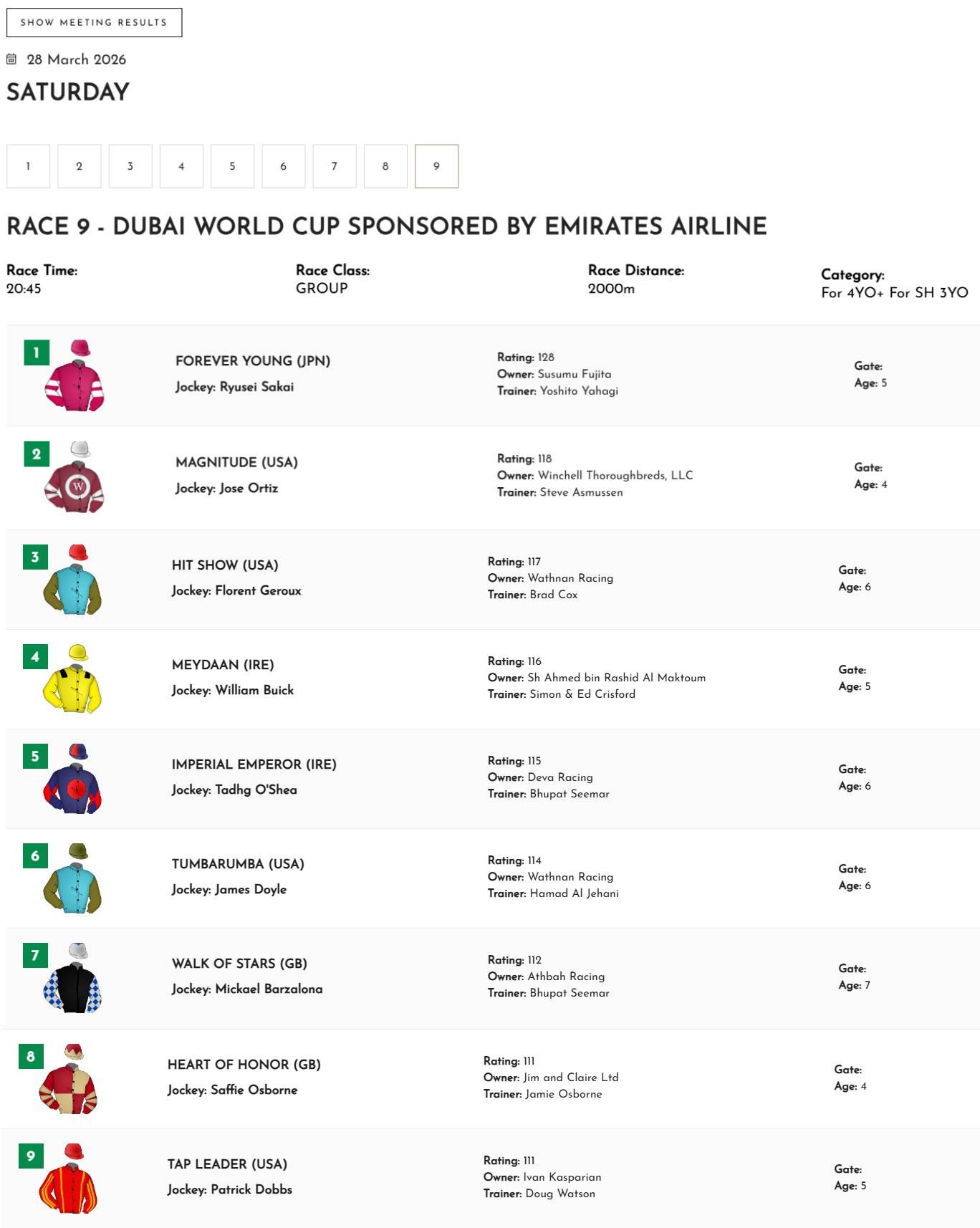
And now, the Dubai World Cup 2026 race card is live. This is the document every horseracing enthusiast studies before the race begins. The racecard tells you all the entries, exactly who is running, who is riding, and how strong each contender is on paper. The horses who have dropped out at the last moment have been marked as ‘Non Runner’.
LATEST
- Dubai World Cup Results 2026: All nine races have concluded. Beautiful day, beautiful races. Check out who won in each race, and how much they all are taking home!
- Magnitude wins the Dubai World Cup: America’s Magnitude takes home the first spot.
- Dubai World Cup 2026 Prize Money: How much is the prize pot for each of the races? What’s the share for jockey? Find out here
Here, you’ll find the Dubai World Cup racecard – by Dubai Racing Club (containing final entries of horses, jockeys, and their details), as well as by others by others, some, that include odds. In addition, you will learn how to read every detail on the race card with a clear guide.
Dubai World Cup 2026 Race Card
Due to the current regional tensions, this year’s racecard was marked by a lot of uncertainty. Now finally, the final list of entries in this year’s Dubai World Cup is out.
Dubai World Cup Racecard 2026 PDF is available: Download in English | Download in Arabic
Note – The document uploaded here was last updated on 26 March @ 2 pm. Please check dubairacingclub.com to check if there has been any changes to the race card.
The DWC is a full day event with nine horse races.
The ninth race is the Dubai World Cup. Racecard for the ninth race is as follows. Though you will find race cards for all races happening on the Dubai World Cup for horseracing in the link above.
Not yet booked your Dubai World Cup ticket? Book your ticket now!
Read this before you go: Dubai World Cup Dress Code
Confused which ticket to buy? See why the recommended ticket option is Apron Views
The official racecard contains horse name, country, age, and several other details, but not odds.
If you are looking for DWC race card with odds, the following links would help.
Dubai World Cup Race Card – With Odds
Several international racing and betting websites also publish the Dubai World Cup race card, with additional data such as odds, probabilities, form analysis, and expert picks.
Check them out:
- MeydanRacing.com (independent guide, not affiliated with Meydan) – Racecard for Dubai World Cup 2026
- horseracingnation.com – Racecard for Dubai World Cup 2026
- horseracing.guide – Click here for racecard with odds
- usracing.com – Click here for racecard with odds
- oddschecker.com – Click here for racecard with odds
- racingpost.com – Click here for racecard with odds
- racingtv.com – Racecard with odds for each race is available as follows Race 1 – Dubai Kahayla Classic
- Race 2 – Godolphin Mile
- Race 3 – Dubai Gold Cup
- Race 4 – UAE Derby
- Race 5 – Al Quoz Sprint
- Race 6 – Dubai Golden Shaheen
- Race 7 – Dubai Turf
- Race 8 – Longines Dubai Sheema Classic
- Race 9 – Dubai World Cup.
- skysports.com – Race-wise racecards are as follows Race 1 – Dubai Kahayla Classic
- Race 2 – Godolphin Mile
- Race 3 – Dubai Gold Cup
- Race 4 – UAE Derby
- Race 5 – Al Quoz Sprint
- Race 6 – Dubai Golden Shaheen
- Race 7 – Dubai Turf
- Race 8 – Longines Dubai Sheema Classic
- Race 9 – Dubai World Cup
More on the DWC is here – Dubai World Cup 2026
How to read the Dubai World Cup Racecard?
At first glance, a race card looks like a table full of numbers and abbreviations. However, every single number on that page tells you something important about the horse’s chances.
This quick guide should help:
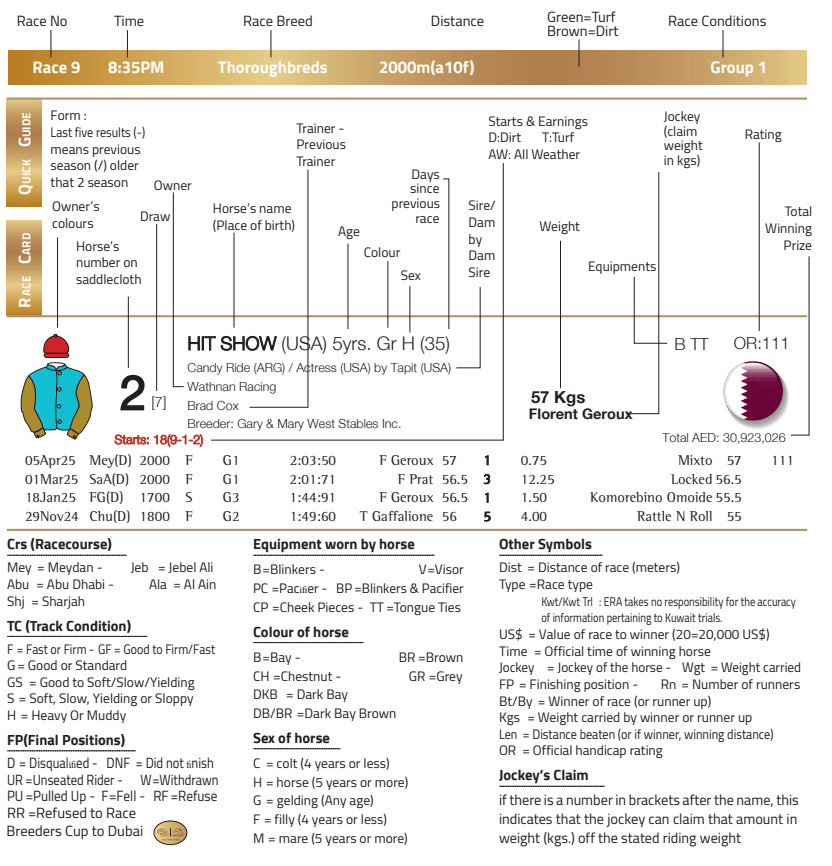
Here are the main things you need to read on a race card:
1. Horse Name
This is the name of the horse running the race. Next to it, you will usually see the country of training (for example JPN, USA, GB, UAE).
Example:
- Forever Young (JPN)
- Hit Show (USA)
- Imperial Emperor (IRE)
This matters because some countries specialise in certain race types and surfaces. For example, Japanese horses are very strong on dirt in recent years.
2. Draw (Barrier / Stall Number)
This is the starting gate number.
In a 2000m dirt race at Meydan, the draw matters because:
- Low draw = shorter distance to the first turn
- Wide draw = horse runs wider, covers more ground
This can affect the result more than people realise.
3. Jockey
The jockey riding the horse.
Top jockeys make a big difference in big races because they:
- Control pace
- Choose racing position
- Time the final run
In races like the Dubai World Cup, jockey bookings are very important.
Example: If a strong horse draws very wide (for example stall 10+), the jockey has to either:
- Use energy early to move forward, or
- Stay wide and lose ground
Both affect the horse’s winning chances.
4. Trainer
The trainer prepares the horse for the race.
Some trainers specialise in big international races, some in sprint races, some in dirt races. Serious followers always check the trainer.
Example: If you see a trainer like Bhupat Seemar on the race card, that matters. He trains in the UAE and knows Meydan and dirt racing conditions extremely well. A locally based trainer often has an advantage because:
- The horse is already acclimatised
- The trainer knows the track
- The horse does not need long travel before the race
5. Weight
This is the total weight the horse carries (jockey + saddle).
More weight = harder for the horse to run fast over long distance. In handicap races this matters a lot, but even in Group races it still matters.
6. Official Rating (OR)
This is the horse’s performance rating given by racing authorities.
Higher rating = better past performance.
Example concept:
- Horse rated 120 is usually stronger than horse rated 110
- But if the 110-rated horse loves dirt and 2000m, and the 120-rated horse prefers turf, the lower-rated horse can still win
So rating is important, but it must be read along with distance and surface.
7. Recent Form (Last Runs)
You will see numbers like:
1 2 3 5 1 4
These are finishing positions in recent races:
Example:
- A horse with form 1 1 2 1 = very strong recent performance
- A horse with form 7 8 6 5 = poor recent performance
You may also see:
- C = won at this course (Meydan)
- D = won at this distance (2000m)
- CD = won at this course and distance
If a horse has CD, that is a big positive sign.
This section tells you whether the horse is in good form.
8. Distance
For the Dubai World Cup, the distance is 2000 metres.
Not every horse is good at every distance.
Some horses are sprinters (1200m–1400m). Some are middle-distance horses (1800m–2000m). Some are stayers (2400m+).
The Dubai World Cup is 2000m, so you want horses that have performed well around this distance before.
9. Surface
The Dubai World Cup is run on dirt, not turf.
This is very important because:
- Some horses run very well on turf but badly on dirt
- Dirt specialists are very dangerous in this race
Example: Some horses run very well on turf but perform poorly on dirt. Dirt races are faster early and more physical. Dirt horses and turf horses are often completely different types.
This is why Japanese and American horses are often strong in this race — they have more dirt racing experience.
10. Odds
Odds are not always on the official race card, but betting websites publish them.
Odds tell you the market’s expectation of which horse is most likely to win.
- Low odds = favourite
- High odds = outsider
But favourites do not always win. The race card helps you understand whether the favourite is actually strong or just popular.
Betting Laws in the UAE and the Dubai World Cup
The UAE has strict gambling laws. In general, betting and gambling are illegal under UAE federal law. This applies to casinos, sports betting, and online betting platforms.
However, horse racing operates in a unique legal space in the UAE.
The Dubai World Cup and other races in the UAE are organised by official bodies such as the Dubai Racing Club and regulated by the Emirates Racing Authority. On-course betting as seen in countries like the UK is not available in the same way in the UAE. Instead, the focus in the UAE racing industry is on prize money, horse ownership, and international racing participation rather than public gambling.
Many international betting websites publish odds for the Dubai World Cup because the race is run under international racing rules and attracts global bettors. However, residents of the UAE should understand that using gambling websites, or betting in any shape or form, while physically in the UAE falls into a legal grey area and can be restricted under local laws.
This is why many people in the UAE follow the race card, form, and predictions for knowledge and interest, even if they are not placing bets locally.
Disclaimer: Always check the latest UAE laws and regulations regarding online betting and gambling before using any betting platform.
FAQs
Q. Where can I find the Dubai World Cup 2026 race card?
A. You can find the official Dubai World Cup 2026 race card on the Emirates Racing Authority website under the Declarations section and on the Dubai Racing Club website. Several international racing and betting websites also publish the race card along with odds, ratings, and race analysis.
Q. What does the Dubai World Cup race card show?
A. The Dubai World Cup race card shows the list of horses running in the race along with their draw number, jockey, trainer, weight carried, official rating, and recent race form. It is the official document that tells you who is running and provides key performance information about each horse.
Q. When is the Dubai World Cup 2026 race card released?
A. The Dubai World Cup race card is released in stages. First, the entries are announced, then the declarations are published a few days before the race, and this declarations stage is when the final race card is confirmed with the official list of runners and draw numbers.
Q. What is the difference between entries and declarations in horse racing?
A. Entries are the horses that are nominated for the race in advance, but they are not all guaranteed to run. Declarations are the final confirmed horses that will actually run in the race, and this is what forms the final race card.
Q. How do you read a Dubai World Cup race card?
A. You read a Dubai World Cup race card by looking at the horse’s official rating, recent form, distance record, dirt record, draw number, jockey, and trainer. These factors together help you understand which horses are the strongest contenders in the race.
Q. Why is the Dubai World Cup race card important for bettors?
A. The race card is important for bettors because it contains all the key information needed to analyse the race, including horse ratings, recent performance, draw position, and jockey bookings. Bettors use this information along with odds to decide which horse to bet on.
Q. How many horses run in the Dubai World Cup 2026?
A. The Dubai World Cup typically has a maximum field of around 12 horses, but the final number depends on the declarations. For the Dubai World Cup 2026, the final declared field shows nine horses set to run in the race.
Q. What is the distance and surface of the Dubai World Cup race?
A. The Dubai World Cup is run over 2000 metres on dirt at Meydan Racecourse in Dubai. This is important because some horses perform better on dirt than on turf.
Q. Do betting websites and official race cards show the same information?
A. Official race cards show the confirmed runners and official race information, while betting websites show the race card along with odds, probabilities, tips, and predictions. Many people use both together before the race.