Rules for Renewing Investor Visas in Dubai Have Changed (Confirmed)
Changes in investor visa renewals in Dubai are now definitely in place. As of January 2026, firsthand renewal experiences now confirm that changes are being actively implemented. Even though no formal announcement outlining these changes has been published on official platforms such as the ICP, GDRF

Changes in investor visa renewals in Dubai are now definitely in place.
As of January 2026, firsthand renewal experiences now confirm that changes are being actively implemented. Even though no formal announcement outlining these changes has been published on official platforms such as the ICP, GDRFA, or u.ae.
What’s New: Dubai Invitational 2026
What Has (Definitely) Changed in the Investor Visa Renewal Process
Based on multiple renewal cases processed in January 2026, and confirmed through free zone communications, the following requirements are now being enforced for partner and investor visa renewals:
1. Minimum Corporate Bank Balance Requirement
Renewal applications are now being reviewed alongside a six-month corporate bank statement, showing:
- consistent monthly transactions, and
- an ending balance of at least AED 50,000
This requirement applies to the company’s account, not a personal account. The statement must clearly indicate the covered period and currency, and is preferably submitted in English or Arabic.
While bank statements have previously been requested in certain cases, the introduction of a specific minimum balance threshold marks a clear shift toward financial substance checks during renewals.
2. Utility Bill in the Applicant’s Name
As per recent immigration directives now being enforced by free zones:
- a utility bill under the visa applicant’s own name is required for investor and partner visa renewals
- applicants without such a bill may still proceed, but must acknowledge a risk of rejection
This requirement directly affects founders who stay in hotels, serviced apartments, or short-term accommodations, where utility accounts are not issued in the resident’s name.
Notably, these requirements are being enforced even though they are not yet clearly published on the official websites of the federal or Dubai-level immigration authorities.
Read: 5 Things Dubai Forced Me to Confront… Fast
While these two requirements are now clearly being enforced, they may not be the last. Scattered reports and advisory notes from service providers suggest that additional changes are already in the pipeline, though they have not surfaced uniformly across all renewal cases yet.
A Personal Real-Life Experience (Jan 2026)
I set up my company in a Dubai free zone a few years ago. This (Jan 2026) was my second visa renewal since incorporation.
The first time around, the process was uneventful. From application to Emirates ID, everything wrapped up in about ten days. It was smooth enough that I didn’t give the process much thought this time either. Based on that earlier experience, I planned my travel and stay accordingly. Our visas were due to expire in the middle of January, and we assumed a similar timeline would apply.
Like most founders in Dubai, I handled the renewal through a PRO – a Public Relations Officer, which in the UAE context refers to licensed firms that manage company formation, visa processing, and liaison with government departments. These are the same firms that help you register your company in a free zone in the first place.
What you only learn later is that once you are registered through a PRO, the free zone will communicate only through them, not directly with you.
We engaged the same PRO that had helped us set up the company.
The process began exactly as expected.
The renewal application was submitted by the PRO.
⬇
Medical examination dates were issued promptly.
⬇
The medical centre was close to where we were staying, and the entire visit took no more than five to ten minutes.
⬇
The reports were uploaded within twenty-four hours.
Up to this point, there was nothing to suggest that this renewal would be any different from the last one.
Then came the first surprise.
We received an email from the free zone asking for our corporate bank statement.
This was new. More importantly, it came with a financial expectation: A six-month bank statement showing consistent activity and a minimum balance threshold.
Fortunately, we already met the requirement, even before knowing it existed. The documents were submitted immediately, and once again, we waited…
As the visa expiry date approached, the waiting became uncomfortable. With barely a day to go, we were already on edge when our PRO forwarded another message from the free zone.
This time, the application had been sent back.
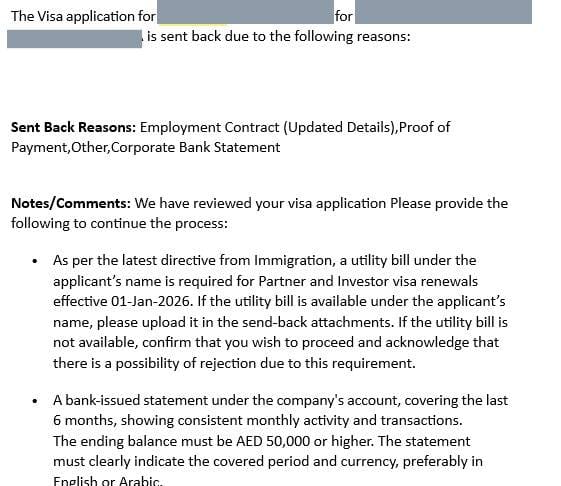
The request was clear and unsettling: under a new directive effective 1 January 2026, a utility bill in the applicant’s name was now required for partner and investor visa renewals. If the utility bill was not available, we could still choose to proceed – but only after acknowledging the risk of rejection.
That was the problem.
Our issue: We do not yet live long-term in Dubai. Every time we visit, we stay in hotels or serviced apartments. There has never been a reason to maintain a utility account in our own names. Until now.
We reached out to the free zone directly. The response was brief and consistent: all communication had to go through the PRO.
At that point, there was little we could do but comply where possible and wait. What was clear, however, was that the rules had changed while our renewal was already in motion.
At the time of publishing this article, we are awaiting things to go through without the utility bill.
A City That Moves Faster Than Its Rulebooks
Dubai attracts founders and investors from around the world because of its business-friendly environment, efficient systems, and policies that make it relatively convenient to set up, operate, and scale companies. It is a city built to reduce friction. And for many years, that predictability has been a significant part of its appeal.
But fortunately, or unfortunately, that landscape has been changing.
In the recent past, Dubai has begun tightening requirements and revising processes at a noticeably faster pace.
| Column 1 | Column 2 |
|---|---|
| + | On the positive side, this shift signals a move toward stronger compliance, greater seriousness, and higher-quality businesses. It raises the bar, and reinforces the idea that incorporation here is meant for companies with real intent and substance. |
| – | On the other hand, for founders who are new to the country, rapid changes, especially when they are implemented without prior public notice, can be genuinely challenging. |
Once you establish a business in the UAE, compliance is expected. Most founders actively track updates and announcements from official government channels such as:
- the Federal Authority for Identity, Citizenship, Customs and Port Security (ICP)
- the General Directorate of Residency and Foreigners Affairs (GDRFA) Dubai
- and the official UAE government portal (u.ae)
These are the places where one reasonably expects visa rules and residency requirements to be published and clarified.
When changes begin to surface operationally (through free zones, during live applications, or via send-back notices) without being clearly reflected on these official platforms, it creates uncertainty.
Still, this is also very much in character for Dubai.
It is a fast-paced city. Decisions are made quickly. Systems evolve quickly.
Recommended Read: Why Dubai Feels Fast (And It’s Not the Cars)
For those choosing to build here, this is part of the environment—one that rewards anticipation as much as adaptation.
The direction is clear: requirements willbecome stricter in the coming years. But they will also make the ecosystem stronger.
In Dubai, speed is everywhere… And surviving, and succeeding, here increasingly means learning to move just ahead of the curve.