How to File Corporate Tax in the UAE on EmaraTax in 2026: Step-by-Step Guide With Screenshots
You file your UAE corporate tax return yourself, online, inside EmaraTax — the Federal Tax Authority’s tax portal at eservices.tax.gov.ae. You log in, open your company’s Taxable Person profile, click Corporate Tax in the left-hand menu, open Corporate Tax Filings, click File next to the tax period,

You file your UAE corporate tax return yourself, online, inside EmaraTax — the Federal Tax Authority’s tax portal at eservices.tax.gov.ae. You log in, open your company’s Taxable Person profile, click Corporate Tax in the left-hand menu, open Corporate Tax Filings, click File next to the tax period, fill in eight sections, tick the declaration and press Submit. Then you pay what the portal calculates.
The deadline is nine months from the end of your financial year. If your financial year ended on 31 December 2025, your return and your payment are both due by 30 September 2026. There is no separate filing fee and no paper form — EmaraTax is the only way to do it.
This guide walks through every screen, in order, in plain language. The screenshots come from the Federal Tax Authority’s own Corporate Tax Return Taxpayer User Manual and from the live EmaraTax portal, so what you see below is what you will see on your screen.
Quick answer
File at eservices.tax.gov.ae → log in → View your Taxable Person → Corporate Tax → Corporate Tax Filings · View All → File → complete the eight sections → Submit → pay by GIBAN bank transfer or card. Deadline: 9 months after your financial year ends. Rate: 0% on the first AED 375,000 of taxable income, 9% above it. Filing is compulsory even if you made a loss, earned nothing, or claim Small Business Relief.
| Filing corporate tax in the UAE — the essentials | |
|---|---|
| Where you file | EmaraTax, the Federal Tax Authority portal — eservices.tax.gov.ae. Online only. |
| Who must file | Every registered Taxable Person: mainland companies, free zone companies, branches, and natural persons whose business turnover passed AED 1,000,000 in a calendar year. |
| Deadline | 9 months from the end of your tax period (Article 53, Federal Decree-Law No. 47 of 2022) |
| Payment deadline | The same 9 months (Article 48). Filing early does not move the payment date later. |
| Rate | 0% on taxable income up to AED 375,000; 9% on the rest |
| Free zone companies | 0% on Qualifying Income if you meet all the Qualifying Free Zone Person conditions; 9% on everything else. You still register and still file. |
| Small Business Relief | Revenue AED 3,000,000 or less — elect it inside the return and you are treated as having no taxable income. You still file, on a shorter form. |
| Sections in the return | 8 on screen: Taxpayer Details, Elections, Accounting Schedules, Accounting Adjustments and Exempt Income, Reliefs, Other Adjustments, Tax Liability and Tax Credits, Review and Declaration |
| Filing a nil return | Yes. Loss-making, dormant and zero-income companies must still file. |
| Late filing penalty | AED 500 for each month or part of a month for the first 12 months, then AED 1,000 a month |
| Late payment penalty | 14% a year on the unpaid tax, charged monthly, with no upper limit |
| Who can file for you | You, a Legal Representative, or an FTA-registered Tax Agent |
| Record keeping | Keep all records for 7 years after the end of the tax period |
Everything in that table is set by Federal Decree-Law No. 47 of 2022 on the Taxation of Corporations and Businesses, the Cabinet and Ministerial Decisions made under it, and the Federal Tax Authority’s own guides. Sources are listed at the end.
How to File Corporate Tax in UAE on EmaraTax in 2026
- Open a browser and go to eservices.tax.gov.ae.
- Log in with UAE PASS, or with the email address and password you used when you registered for corporate tax.
- You land on the Taxable Person List. Click View under your company’s name. That opens the company dashboard.
- In the menu strip down the left side of the screen you will see HOME, VAT, EXCISE TAX, CORPORATE TAX, MY PAYMENTS and a few more. Click CORPORATE TAX. A page of tiles appears. The first one is Corporate Tax Filings. Click the dark View All button inside that tile.
- Now you are looking at a table with one row for each tax period. Read across the row: Period From, Period To, Due Date, Status. On the far right of the row, under the column headed Action, there is a small link that says File. Click it. The return opens.
[For detailed guide with screenshots, scroll down…]
The return itself is eight numbered sections. A bar across the top shows all eight and highlights the one you are on. You move forward with the Next Step button at the bottom right and backwards with Previous Step at the bottom left. Save as Draft sits between them, and it is worth pressing often. Finish the eighth section, tick the declaration, press Submit, and the status of that row changes to Submitted.
That is the whole journey. The rest of this guide is the detail: what to have ready first, what each of the eight sections actually asks you, and how to pay once the return is in.
One thing before you start. The return asks for numbers you cannot invent on the spot — your revenue, your net accounting profit, your fixed assets, sometimes an auditor’s name. If you open the form without those figures in front of you, you will get four screens in and stop. So get the paperwork together first. The next section is the list.
Deadline now
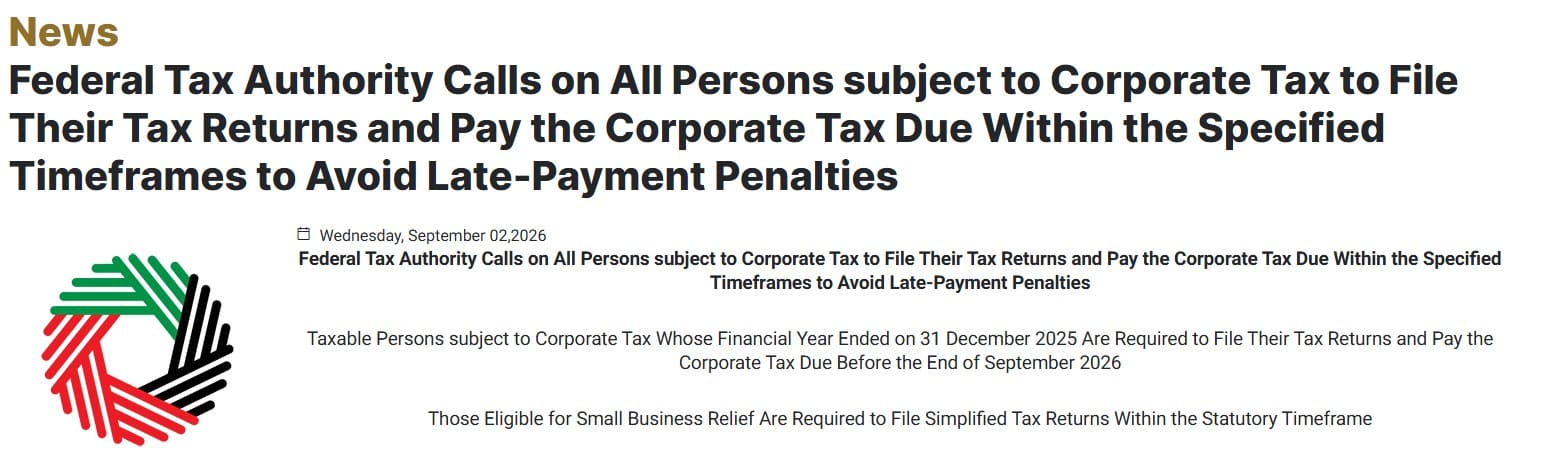
The Federal Tax Authority stated on 2 September 2026 that Taxable Persons whose financial year ended on 31 December 2025 must file their return and pay the tax due before the end of September 2026. Companies eligible for Small Business Relief must file a simplified return within the same window.
What to keep ready before you file corporate tax in the UAE on EmaraTax?
Gather these before you open the return. EmaraTax lets you save a draft, but a half-filled return that sits open for three weeks is how deadlines get missed.
| Pre-filing checklist | |
|---|---|
| EmaraTax login | Your UAE PASS, or the email and password used at registration. If a staff member registered the company and has left, sort the login out first — password resets take time. |
| Corporate Tax TRN | Your 15-digit Tax Registration Number for corporate tax. It is not the same number as your VAT TRN. EmaraTax fills this in for you, but you should recognise it. |
| Your tax period dates | The exact start and end of the financial year you are filing for. EmaraTax shows them at the top of the return and you cannot change them there. |
| Financial statements | Income statement, statement of financial position, and statement of other comprehensive income for that year, prepared on the correct accounting standard. |
| Trial balance | The return asks for figures your statements summarise. Have the trial balance open so you can trace a number when it does not match. |
| Audit details | If you must have audited accounts, the return asks whether the accounts were audited and for the auditor’s name. |
| Revenue split (free zone only) | Qualifying Income against non-qualifying revenue, so you can complete the Free Zone schedule and the de minimis test. |
| Related party list | Transactions with related parties and connected persons, with values, so you can check them against the disclosure thresholds. |
| Loss and interest carry-forwards | Tax losses and disallowed net interest brought forward from earlier tax periods. |
| Supporting documents | PDF copies for the Attachments schedule. If you leave something out, the form asks you to type a reason. |
Which accounting standard applies to you
Ministerial Decision No. 114 of 2023 sets this, and it turns entirely on your revenue.
| Your revenue for the tax period | Accounting basis you may use |
|---|---|
| Above AED 50,000,000 | IFRS |
| AED 50,000,000 or below | IFRS, or IFRS for SMEs |
| AED 3,000,000 or below | IFRS, IFRS for SMEs, or the cash basis. On the cash basis you complete only the income statement part of the Accounting Schedule. |
Do you need audited accounts?
Two groups must have audited financial statements, under Ministerial Decision No. 84 of 2025:
- any Taxable Person that is not a Tax Group with revenue above AED 50,000,000 in the tax period;
- every Qualifying Free Zone Person, whatever its revenue — a free zone company claiming the 0% rate needs an audit even if it earned very little;
- a Tax Group must prepare audited special purpose financial statements.
If you fall into either group, EmaraTax pre-fills the audit question in the return as Yes and you cannot change it. The auditor must be licensed in the UAE.
Transfer pricing files — only if you are large
You must prepare a Local File and a Master File only if either of these is true, under Ministerial Decision No. 97 of 2023:
- your own revenue in the tax period is AED 200,000,000 or more; or
- you are part of a multinational group with total consolidated revenue of AED 3,150,000,000 or more.
You do not upload these with the return. You keep them and hand them over within 30 days if the FTA asks — that deadline comes from Article 55 of the Corporate Tax Law, while the two thresholds come from the Ministerial Decision.
Keep everything for seven years
Article 56 of the Corporate Tax Law requires all records and documents to be kept for seven years after the end of the tax period they relate to. From 30 July 2026, FTA Decision No. 4 of 2026 adds rules on how: scanned copies must be complete and legible, partial scans are not accepted, pages must stay in their original order, and the FTA can require access to the system the records sit in, including passwords.
Step by step: filing your corporate tax return on EmaraTax
Fifteen steps. The first five get you to the form. Steps six to fourteen are the form itself. Step fifteen is paying.
Step 1 — Log in to EmaraTax
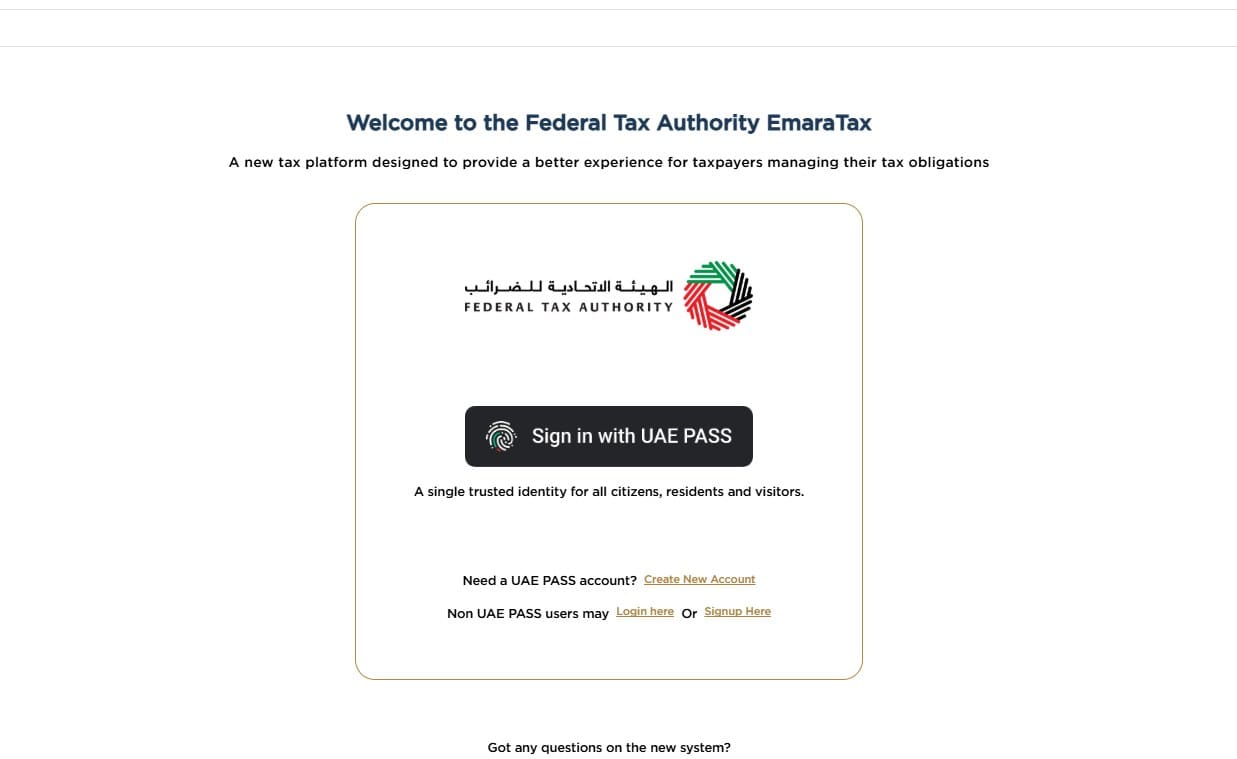
Go to eservices.tax.gov.ae. The welcome screen offers a black Sign in with UAE PASS button in the middle of a bordered card. UAE PASS is the fastest route: you tap approve on your phone and you are in.
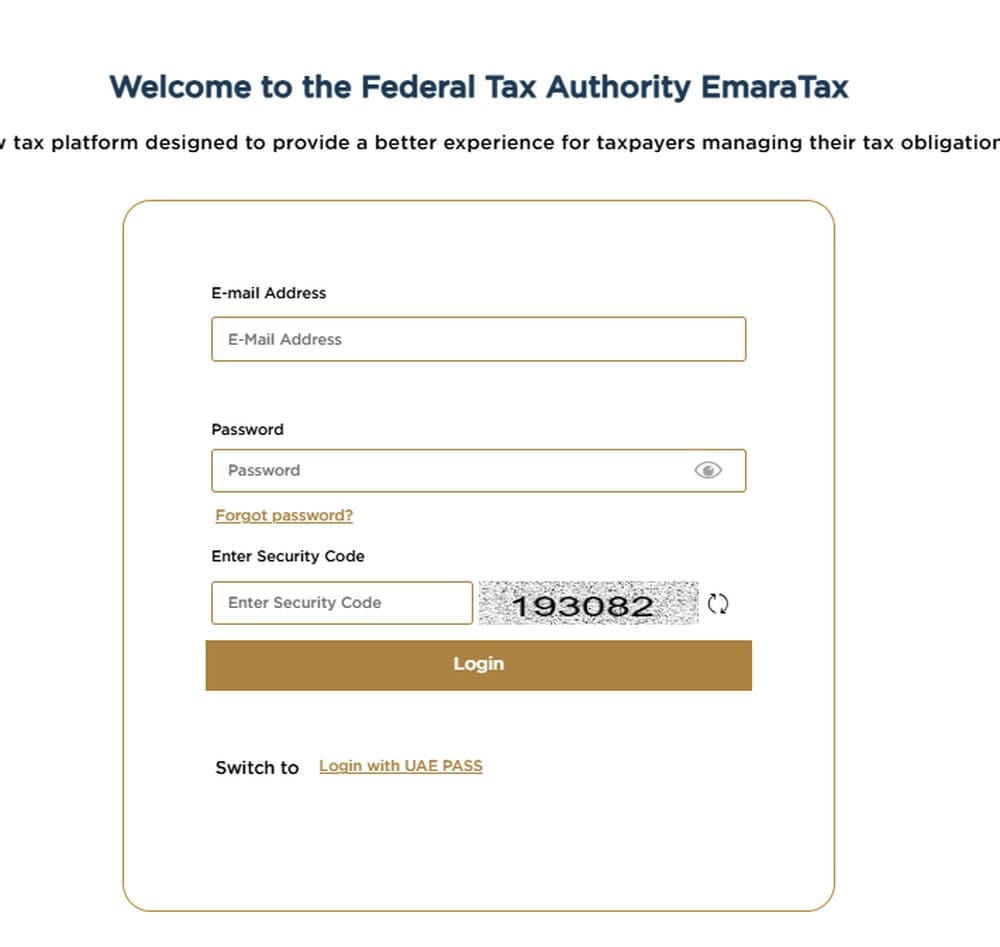
If your account was created with an email address instead, look at the bottom of the same card for the line “Non UAE PASS users may Login here” and click the underlined Login here. The card swaps to three fields: E-mail Address, Password and a security code you copy from the image beside it. Then press the gold Login button.
If you cannot get in
Use Forgot password? under the password field, not a new account. Registering a second time creates a duplicate profile and a mess that takes weeks to unpick. If the email on the account belongs to someone who has left the company, contact the FTA on 800 82923 before the deadline, not after it.
Step 2 — Open your company’s Taxable Person profile
After login you land on the Taxable Person List. Each company you are linked to shows as a card with its name and a dark View button along the bottom of the card. Click View on the company you are filing for.
If you handle more than one company, check the name twice. Filing a return under the wrong Taxable Person means a voluntary disclosure later.
Step 3 — Click CORPORATE TAX in the left menu
The company dashboard opens. Down the left-hand side is the main menu: HOME, then your tax types — VAT, EXCISE TAX, CORPORATE TAX — then MY PAYMENTS, MY CORRESPONDENCE, USER AUTHORIZATION, MY AUDIT, MY REPORTS and OTHER SERVICES.
Click CORPORATE TAX. It turns gold to show it is selected.
Step 4 — Open Corporate Tax Filings
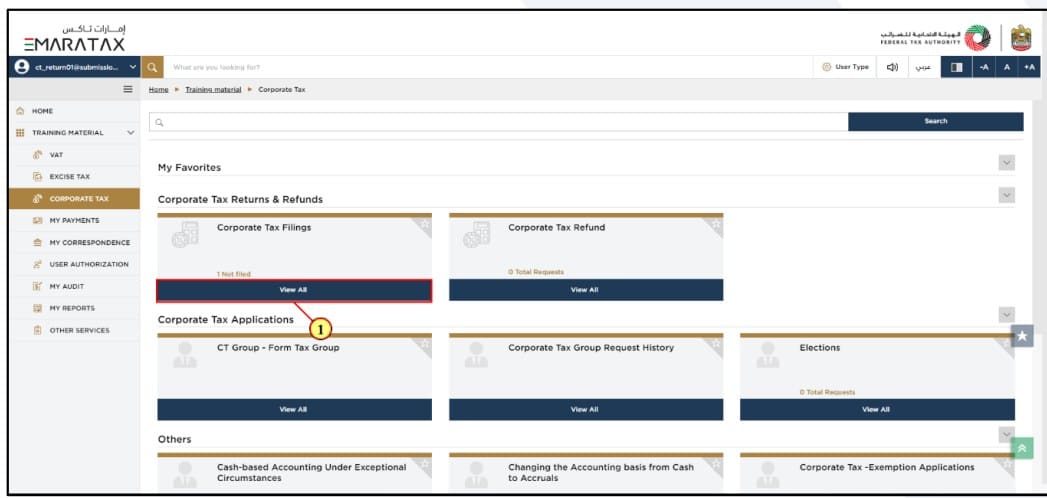
The Corporate Tax page is a grid of tiles grouped under headings. The first group is Corporate Tax Returns & Refunds, and the first tile in it is Corporate Tax Filings. Under the tile name you will see a small gold line such as 1 Not filed — that is your unfiled return waiting.
Click the dark blue View All bar at the bottom of the Corporate Tax Filings tile. Not the Corporate Tax Refund tile beside it, and not the Elections tile below it.
Step 5 — Find your tax period and click File
A table called Corporate Tax Filings opens, one row per tax period. Reading across: Type, Application Number, Period Description, Period From, Period To, Due Date, Submission Date, Net Corporate Tax Position, Status, and last of all Action.
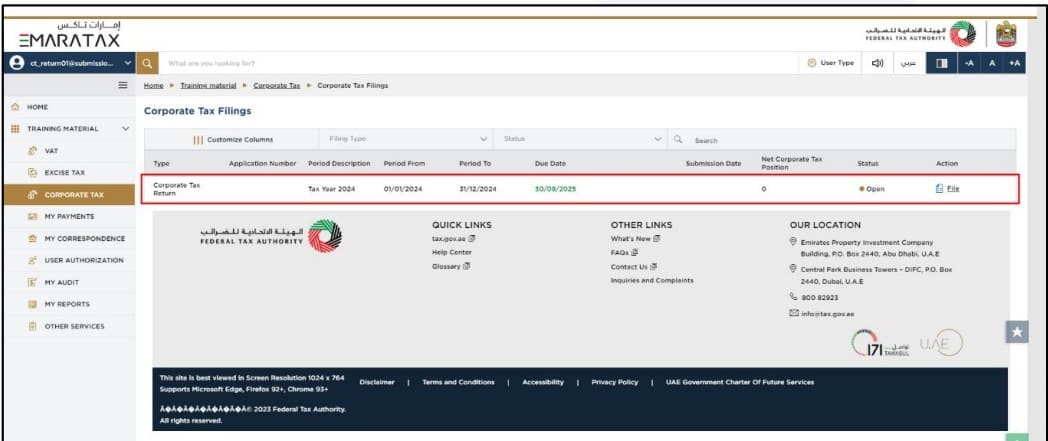
Check the Period From and Period To dates match the year you mean to file. The Due Date shows in green. On the far right of that row, in the Action column, is a small link with a document icon that reads File. Click it.
No File link? If the Action column is empty or the row does not exist, the tax period has not opened yet — EmaraTax only opens a return after the period has ended. If the whole Corporate Tax menu is missing, the company is not registered for corporate tax, and registration comes first.
Step 6 — Understand the eight sections before you type anything
The return opens on a screen with a numbered bar across the top. Those eight circles are the whole return:
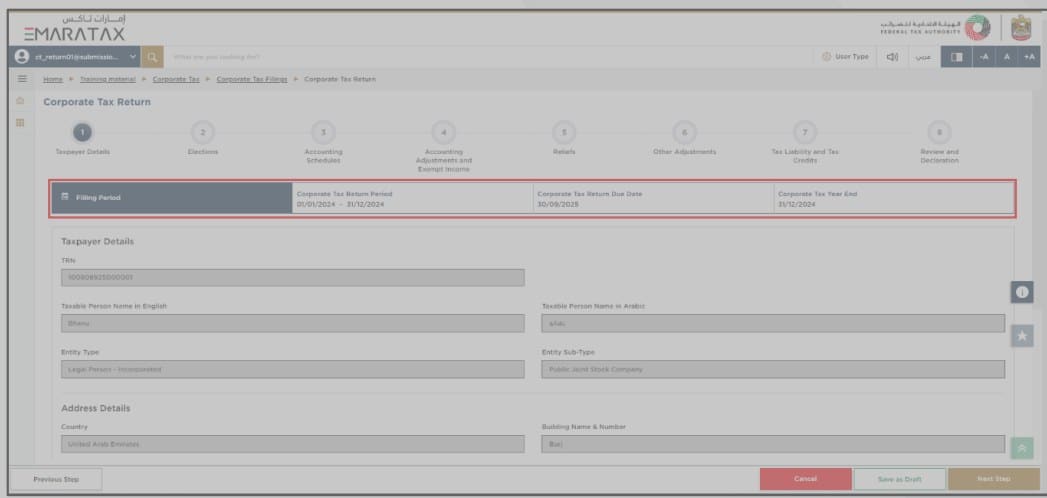
Two things make this easier than it looks. First, EmaraTax only shows you the fields and schedules that can apply to you — a small mainland trading company never sees the free zone questions. Second, the buttons never move: Previous Step at the bottom left, and Cancel, Save as Draft and Next Step at the bottom right.
Amounts are entered in UAE dirhams, rounded to the nearest dirham. Fields with a grey background are filled by EmaraTax from your registration and cannot be typed over.
Step 7 — Section 1: Taxpayer Details
This section is a check, not a typing exercise. EmaraTax fills in your TRN, the company name in English and Arabic, the entity type and sub-type, and the address. A grey strip near the top called Filing Period shows three things worth reading carefully: Corporate Tax Return Period, Corporate Tax Return Due Date, and Corporate Tax Year End.
Read those three. If the period is wrong, stop. You cannot fix it inside the return — it has to be corrected in your registration details first. If everything is right, press Next Step.
Step 8 — Section 2: Elections (this is where Small Business Relief lives)
An election is a choice you make once in the return that changes how your income is taxed. There are six, and EmaraTax shows you only the ones you are eligible for.
| Election | What it does | How long it lasts |
|---|---|---|
| Small Business Relief | Treats you as having no taxable income for the period. Revenue must be AED 3,000,000 or less. | Every year you want it — an annual choice |
| Realisation basis | Taxes gains and losses only when you actually realise them, not when they are revalued. | First tax period only, then it cannot be undone |
| Transitional rules | Adjusts the opening value of property, intangibles and financial instruments you held before corporate tax started. | First tax period only, then it cannot be undone |
| Transfers within a Qualifying Group | Moves assets between group companies without triggering tax. | Cannot be undone |
| Business Restructuring Relief | Defers tax on a qualifying merger, transfer or restructuring. | Chosen per transaction |
| Foreign Permanent Establishment exemption | Leaves the profits and losses of a foreign branch out of your UAE return. | Annual choice |
The Federal Tax Authority is blunt about the effect: once an election is made in the return, it applies — there is no confirmation step and no approval letter afterwards. Get it right here.
Small Business Relief in one line
If your revenue — not profit, revenue — is AED 3,000,000 or less for the tax period and you are not in a multinational group and not a Qualifying Free Zone Person, tick Small Business Relief. You are then treated as having no taxable income, you fill in far fewer fields, and your tax is nil. You still have to file. Relief from tax is not relief from filing.
Two costs come with it, and neither is obvious. A tax loss made in a year you claim Small Business Relief cannot be carried forward to a later year, and neither can disallowed net interest. If you made a real loss, work out whether carrying it forward is worth more than the relief before you tick the box.
The relief was originally due to end with tax periods ending on 31 December 2026. Ministerial Decision No. 131 of 2026, issued on 29 July 2026, extended it to tax periods ending on or before 31 December 2029. A lot of pages online still show the old date.
Step 9 — Section 3: Accounting Schedules
This is where your financial statements go in. It is the longest section and the one that needs the trial balance beside you. It has four parts: the income statement, the statement of other comprehensive income, the statement of financial position, and an audit question.
The FTA describes this whole section as being for disclosure purposes only — the numbers here do not by themselves calculate your tax. They are the picture of the business the FTA wants on record. Enter them standalone, not consolidated, unless you are a Tax Group.
If you use the cash basis because your revenue is AED 3,000,000 or less, you complete only the income statement part.
The audit question asks whether your financial statements were audited. If your revenue is above AED 50,000,000, or you are a Qualifying Free Zone Person, EmaraTax has already answered Yes for you and you must give the auditor’s name.
Step 10 — Section 4: Accounting Adjustments and Exempt Income
Accounting profit and taxable income are not the same number. This section is where you bridge the two.
You take out income that is exempt — dividends from UAE companies, qualifying participation income from shareholdings that meet the rules, and profits of a foreign branch if you elected the exemption. You add back costs the law does not allow, such as fines and penalties, bribes, donations to bodies that are not approved, and the disallowed half of entertainment costs.
Each exemption you claim opens its own schedule further down the return — a UAE Dividends schedule, a Participation Exemption schedule, a Foreign Permanent Establishment schedule. Fill in the schedule, not just the summary line.
Small errors from earlier years
If you find a mistake in a previous tax period and the tax effect is AED 10,000 or less, you can correct it inside this return. Anything larger needs a separate Voluntary Disclosure, and a voluntary disclosure carries its own penalty of 1% a month on the tax difference.
Step 11 — Section 5: Reliefs
Reliefs are the group-level and restructuring claims: transfers within a Qualifying Group, Business Restructuring Relief, and the tax loss position. If you elected any of them in Section 2, this is where the numbers go.
Tax losses are handled here too. A loss carried forward can cover no more than 75% of the taxable income of the year you use it in, so a loss rarely wipes out a profitable year in one go.
Step 12 — Section 6: Other Adjustments
Interest, transfer pricing and unrealised gains sit here.
The interest capping rules limit how much net interest expense you can deduct. The related party rules require your dealings with connected businesses and people to be priced as if they were strangers — the arm’s length principle. Whether you have to disclose those dealings depends on three thresholds:
| Threshold | What it triggers |
|---|---|
| Aggregate related party transactions above AED 40,000,000 | The Related Party Transaction schedule opens. |
| Then, per category, above AED 4,000,000 | Each category over this figure must be listed separately — goods, services, intellectual property, interest, assets, liabilities, other. |
| Connected persons above AED 500,000 each | The Connected Persons schedule opens, listing payments or benefits to each owner, director or officer and their related parties. |
Dividends declared between related parties do not have to be disclosed and do not count towards the AED 40 million or AED 4 million tests.
Downward adjustments need permission
A transfer pricing adjustment that reduces your taxable income is only allowed after a successful application to the Federal Tax Authority. You cannot simply type it in. The FTA issued a public clarification on this, CTP011, on 15 July 2026.
Step 13 — Section 7: Tax Liability and Tax Credits
You do not calculate the tax. EmaraTax does it from everything you entered: 0% on the first AED 375,000 of taxable income and 9% on the rest. A Qualifying Free Zone Person sees 0% on Qualifying Income and 9% on the rest.
Here is what that means in money. The 0% band is a slice, not a cliff — it applies to every company, so nobody pays 9% on their first AED 375,000.
| What 0% and 9% actually cost | ||||
|---|---|---|---|---|
| AED 300,000 | 300,000 | 0 | AED 0 | 0% |
| AED 375,000 | 375,000 | 0 | AED 0 | 0% |
| AED 500,000 | 375,000 | 125,000 | AED 11,250 | 2.25% |
| AED 1,000,000 | 375,000 | 625,000 | AED 56,250 | 5.63% |
| AED 5,000,000 | 375,000 | 4,625,000 | AED 416,250 | 8.33% |
| AED 10,000,000 | 375,000 | 9,625,000 | AED 866,250 | 8.66% |
Below the calculation you can enter tax credits: withholding tax credits, and foreign tax credit for tax already paid abroad on income that is also taxed here. Claiming a foreign tax credit opens the Tax Credit schedule.
If any figure you have used is an estimate rather than a final number, the return requires you to say so. Do not skip that.
Step 14 — Section 8: Review and Declaration, then Submit
The last screen replays the return for you to check, then asks four things: the date, who prepared the return (yourself, a Tax Agent or a Legal Representative), a confirmation that you have the authority to file, and a confirmation that the information is accurate and complete. You sign by typing your name and your capacity.
This is a legal declaration, not a formality. Corporate tax in the UAE is a self-assessment system: the FTA does not check your figures before accepting the return. It accepts what you say, and can audit it later.
Press Submit. Three things then happen: the row in Corporate Tax Filings changes status to Submitted, you get a submission acknowledgment, and you get a tax liability notification telling you what to pay. Download and keep both.
Filed is not paid
Submitting the return does not move any money. The tax is still due by the same nine-month deadline, and the late-payment penalty runs from the day after it, whether or not the return went in on time.
Step 15 — Pay the corporate tax
Go to MY PAYMENTS in the left menu. EmaraTax shows what is due, then a screen headed Select a Payment Method with a payment summary on the left and two choices on the right: GIBAN and Card Payment.
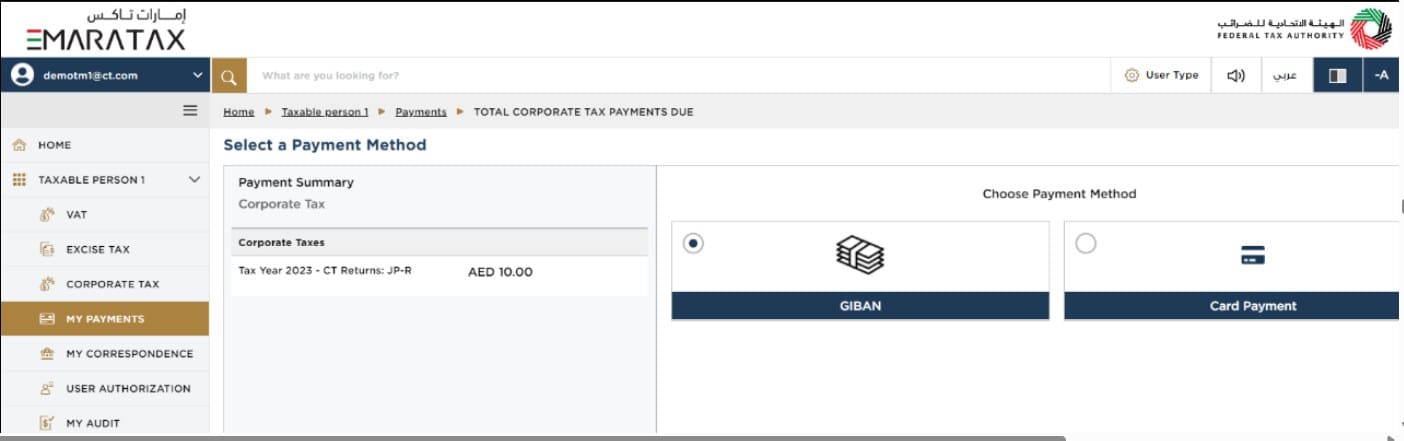
| Method | How it works | Timing and cost |
|---|---|---|
| GIBAN bank transfer | EmaraTax gives you a payment reference. You transfer from your bank to the Central Bank of the UAE, account name Federal Tax Authority – Taxation of Corporations & Businesses, SWIFT CBAUAEAAXXX, routing code 273510101, quoting the reference number. | Local transfers can take up to 24 hours; an international transfer usually takes several working days. The FTA does not publish a guaranteed clearing time, so start well before the deadline — the payment counts when it reaches the FTA, not when you send it. |
| Card payment | Visa or Mastercard — prepaid, debit or credit — through the MagnatiPay gateway inside EmaraTax. | Instant. A fee of 0.68% plus VAT is charged on the amount. |
e-Dirham has gone
The FTA’s payments manual states plainly that e-Dirham is no longer accepted; MagnatiPay replaced it. Corporate tax currently supports GIBAN and card payments only.
Money that arrives is applied to the oldest liability first. If you overpay, the credit sits on your account and is used against the next liability that falls due.
When your return is due
One rule covers everyone: nine months from the end of your tax period. Your tax period is your financial year. Both the return and the payment are due on that same day.
| Nine months, counted from your year end | ||
|---|---|---|
| 31 December 2025 | 1 Jan 2025 – 31 Dec 2025 | 30 September 2026 |
| 31 March 2026 | 1 Apr 2025 – 31 Mar 2026 | 31 December 2026 |
| 30 June 2026 | 1 Jul 2025 – 30 Jun 2026 | 31 March 2027 |
| 30 September 2026 | 1 Oct 2025 – 30 Sep 2026 | 30 June 2027 |
| 31 December 2026 | 1 Jan 2026 – 31 Dec 2026 | 30 September 2027 |
If your first tax period was short or long
A first tax period can run from 6 to 18 months. The nine months still count from the day it ends, not from a calendar date. Check the Corporate Tax Return Due Date shown in Section 1 of the return — that is the date the FTA will use.
What it costs if you are late
The penalties are set by Cabinet Decision No. 75 of 2023, as amended. They are automatic. Nobody has to decide to charge you.
| Corporate tax penalties | |
|---|---|
| Registering for corporate tax late | AED 10,000, once |
| Filing the return late | AED 500 for each month or part month, for the first 12 months. From month 13, AED 1,000 for each month or part month. |
| Paying the tax late | 14% a year on the unpaid amount, applied monthly from the day after the due date. No cap. |
| Not keeping the required records | AED 10,000, rising to AED 20,000 if it happens again within 24 months |
| Records not in Arabic when the FTA asks | AED 5,000 |
| Not telling the FTA about a change to your details | AED 1,000, rising to AED 5,000 for a repeat within 24 months |
| Voluntary disclosure of an error | 1% a month on the tax difference, from the due date until the disclosure is made |
| Error found by the FTA before you disclose it | 15% fixed, plus 1% a month |
The late registration penalty can still be waived
If you were fined AED 10,000 for registering late, the Federal Tax Authority runs a waiver. The condition is simple: file your first tax return or annual declaration within seven months of the end of your first tax period, instead of the usual nine. Do that and the AED 10,000 is waived. If you already paid it, it goes back as a credit on your EmaraTax account.
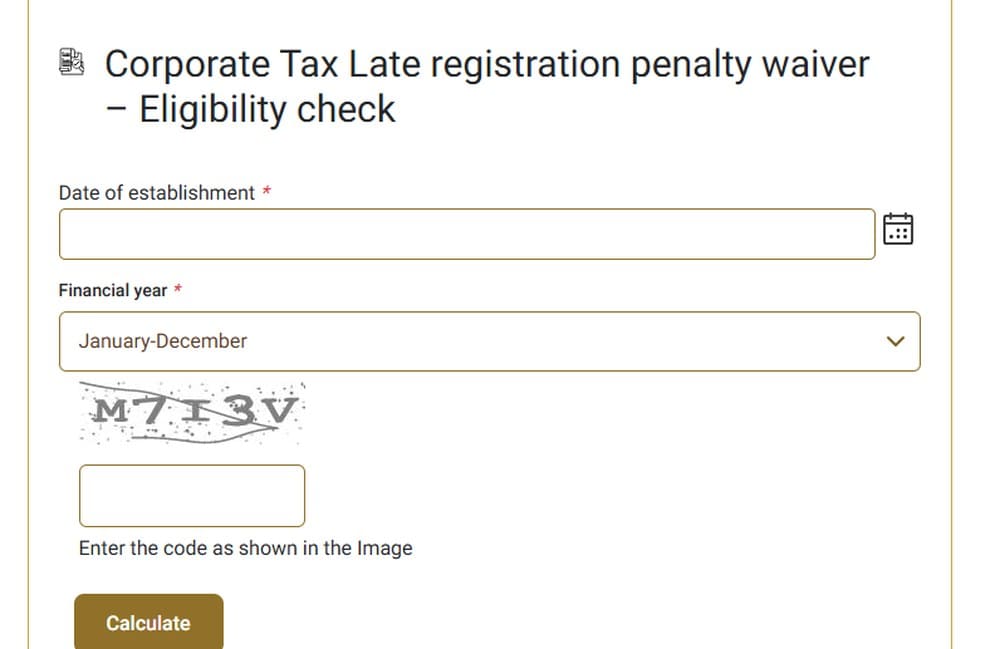
The FTA has an eligibility checker on tax.gov.ae. You enter your date of establishment and your financial year, type the code from the image, and press Calculate.
Free zone companies: you file too
A common and expensive misunderstanding is that a free zone company is outside corporate tax. It is not. A free zone company registers, files and keeps records like everyone else. What it can get is a 0% rate on part of its income.
To be a Qualifying Free Zone Person and pay 0% on Qualifying Income, all of these must be true:
- you have adequate substance in the free zone — real people, real premises, real expenditure, and the core income-generating activities carried out there;
- your income is Qualifying Income as defined by Cabinet Decision No. 100 of 2023;
- you have not elected to be taxed at the normal rates;
- you meet the arm’s length and transfer pricing documentation rules;
- you have audited financial statements;
- your non-qualifying revenue stays inside the de minimis limit — the lower of 5% of total revenue or AED 5,000,000.
Break the de minimis limit or fail any other condition and you lose the 0% rate for that tax period and the next four. That is a five-year consequence from a single year’s mistake, which is why the free zone schedule in the return is worth slow, careful reading.
What counts as Qualifying Income has grown
Ministerial Decision No. 229 of 2025, issued on 3 September 2025, replaced the earlier decision on qualifying and excluded activities and widened commodity trading in qualifying commodities — metals, minerals, energy, industrial chemicals, agricultural commodities and their by-products. The governing list of Qualifying Income in Cabinet Decision No. 100 of 2023 is unchanged.
Who has to file, and who does not
If you are registered for corporate tax, you file. That is the short version, and it catches most people out because they assume no profit means no return.
Individuals in business
A natural person — a sole trader, a freelancer with a licence, a consultant — comes into corporate tax only if turnover from business activities in the UAE went above AED 1,000,000 in a calendar year, under Cabinet Decision No. 49 of 2023. Salary, personal investment income and personal real estate investment income do not count towards that figure and are not taxed.
If you crossed the line, your tax period is the calendar year, and your return is due by 30 September of the following year.
Tax Groups
A UAE parent and its 95%-owned subsidiaries can form a Tax Group and file one return for the whole group. The parent files it. The AED 375,000 zero-rate band applies once to the group, not once per company. Transactions inside the group are eliminated.
Exempt Persons
Government entities, government-controlled entities, qualifying public benefit entities, qualifying investment funds, extractive and non-extractive natural resource businesses, and public and private pension and social security funds are exempt. They still register, and they submit an annual declaration rather than a tax return — also within nine months.
Mistakes that cost money
| The mistake | What it actually costs |
|---|---|
| Assuming no profit means no return | AED 500 a month, growing to AED 1,000 a month after a year. A nil return takes under an hour. |
| Confusing revenue with profit for Small Business Relief | The AED 3,000,000 test is on revenue. A company with AED 4m revenue and AED 200,000 profit does not qualify. |
| Filing on time but paying late | The 14% a year late-payment penalty runs anyway. Two separate obligations, one date. |
| Free zone company that never registered | AED 10,000, plus the 0% rate is not automatic — without the return and the audit you cannot claim it. |
| Ticking Small Business Relief in a loss year | The loss cannot be carried forward. In a bad year the relief can be worth less than the loss. |
| Missing the free zone de minimis limit | The 0% rate is lost for that tax period and the four that follow. |
| Leaving the return in draft | A saved draft is not a filed return. Nothing reaches the FTA until you press Submit on Section 8. |
| Waiting for a reminder | The FTA does not send one before the deadline. The nine months are yours to count. |
What happens after you submit
The FTA does not check your return before accepting it. Corporate tax is self-assessed: you calculate, you declare, and the return is taken at face value. The checking happens later, if at all, through an audit — which is why the seven-year record rule matters.
You can amend a submitted return. If the tax effect of the error is AED 10,000 or less, correct it in your next return. Above that, file a Voluntary Disclosure in EmaraTax within 20 business days of finding the error. Disclosing costs 1% a month on the difference; being found out first costs 15% plus 1% a month.
Keep the submission acknowledgment, the tax liability notification and the payment confirmation together with the financial statements for that year. Seven years.
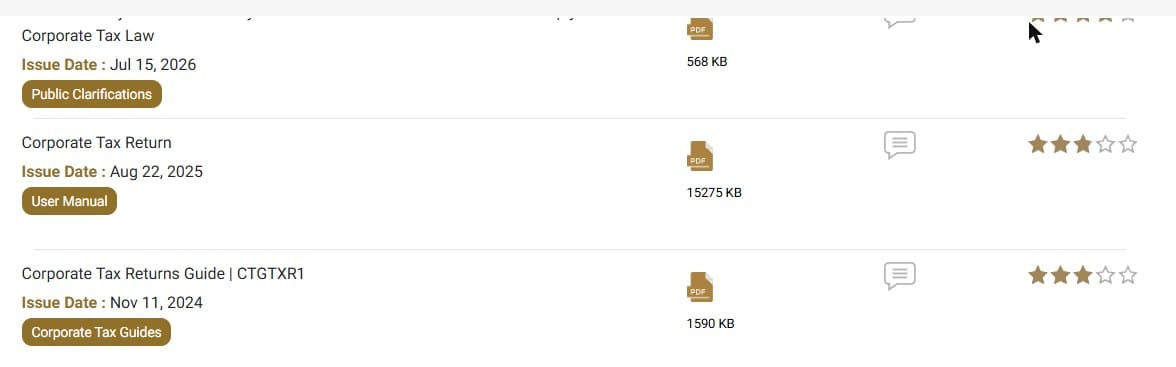
The Federal Tax Authority publishes the full Corporate Tax Return taxpayer user manual and the Corporate Tax Returns Guide (CTGTXR1) free on tax.gov.ae, under Taxes → Corporate Tax → Guides, References & Public Clarifications. Search “Tax Return” on that page. If a screen in this guide looks different on your account, the manual is the authority.
Frequently asked questions
How do I file corporate tax in the UAE?
Log in to EmaraTax at eservices.tax.gov.ae, click View on your Taxable Person, click CORPORATE TAX in the left menu, click View All on the Corporate Tax Filings tile, then click File in the Action column of your tax period. Complete the eight sections, tick the declaration in Section 8 and press Submit. Then pay through MY PAYMENTS by GIBAN transfer or card.
What is the deadline for filing corporate tax in the UAE?
Nine months from the end of your tax period. A financial year ending 31 December 2025 means a deadline of 30 September 2026. The tax payment is due on the same date.
Do I have to file if my company made no profit or no income?
Yes. Every registered Taxable Person must file, including loss-making and dormant companies. A nil return is still a return, and the AED 500 a month late-filing penalty applies if you skip it.
How much is UAE corporate tax?
0% on taxable income up to AED 375,000 and 9% above that. A company with AED 500,000 of taxable income pays AED 11,250. Large multinationals in scope of the global minimum tax face a 15% Domestic Minimum Top-up Tax for financial years starting on or after 1 January 2025.
What is Small Business Relief and how do I claim it?
If your revenue for the tax period is AED 3,000,000 or less, you can elect Small Business Relief in Section 2, Elections, of the return. You are then treated as having no taxable income and complete a much shorter return. Losses and disallowed interest from that year cannot be carried forward. Ministerial Decision No. 131 of 2026 extended the relief to tax periods ending on or before 31 December 2029.
Do free zone companies have to file a corporate tax return?
Yes. Free zone companies register, file and keep records like everyone else. Meeting all the Qualifying Free Zone Person conditions gives you 0% on Qualifying Income, but you must file to claim it, and you need audited financial statements whatever your revenue.
What is the penalty for filing corporate tax late in the UAE?
AED 500 for each month or part month for the first twelve months, then AED 1,000 for each month or part month. Paying late costs a separate 14% a year on the unpaid tax, charged monthly with no cap. Registering late costs AED 10,000.
Can I still get the AED 10,000 late registration penalty waived?
Yes, if you file your first tax return or annual declaration within seven months of the end of your first tax period rather than the usual nine. If you already paid the penalty it is credited back to your EmaraTax account. The FTA has an eligibility checker on tax.gov.ae.
Can I fix a mistake after I have submitted the return?
If the tax effect is AED 10,000 or less, correct it in your next return. Above that, file a Voluntary Disclosure in EmaraTax within 20 business days of noticing it. A voluntary disclosure costs 1% a month on the tax difference; an error the FTA finds first costs 15% plus 1% a month.
Do I need a tax agent to file corporate tax in the UAE?
No. You can file the return yourself in EmaraTax. A Legal Representative or an FTA-registered Tax Agent can file on your behalf, and the return asks which of the three prepared it. For a straightforward small company with clean accounts, the return is a form-filling exercise, not a specialist one.
The bottom line
Filing corporate tax on EmaraTax is a form, not an ordeal. A small company with clean accounts and revenue under AED 3,000,000 can be done in an afternoon: log in, View, Corporate Tax, View All, File, tick Small Business Relief in Section 2, fill in the income statement, sign Section 8, submit. Nothing to pay.
The work is in the preparation, not the portal. Have the financial statements finished on the right accounting standard, know your revenue figure to the dirham, know whether you need an audit, and have the related-party numbers to hand. Companies that miss the deadline almost never miss it because EmaraTax was confusing. They miss it because the accounts were not ready in month eight.
Count your nine months from your own year end, put the date in a calendar with a month of warning, and file before the last week — the portal is busiest, and slowest, in the final days of September.
Sources
- Federal Decree-Law No. 47 of 2022 on the Taxation of Corporations and Businesses — Articles 3, 48, 51, 53, 56 — mof.gov.ae and tax.gov.ae
- Federal Tax Authority, Corporate Tax Return — Taxpayer User Manual, issued 22 August 2025 — tax.gov.ae
- Federal Tax Authority, Corporate Tax Returns Guide (CTGTXR1), 11 November 2024 — tax.gov.ae
- Federal Tax Authority, Corporate Tax Payments — User Manual — tax.gov.ae
- Federal Tax Authority news release, “FTA Calls on All Persons subject to Corporate Tax to File Their Tax Returns and Pay the Corporate Tax Due Within the Specified Timeframes”, 2 September 2026 — tax.gov.ae
- Cabinet Decision No. 75 of 2023 on administrative penalties, as amended — tax.gov.ae
- Cabinet Decision No. 100 of 2023 on Qualifying Income for Qualifying Free Zone Persons; Ministerial Decision No. 229 of 2025 on qualifying and excluded activities, 3 September 2025 — mof.gov.ae
- Cabinet Decision No. 49 of 2023 on natural persons subject to corporate tax — mof.gov.ae
- Ministerial Decision No. 73 of 2023 on Small Business Relief; Ministerial Decision No. 131 of 2026 extending it to 31 December 2029, issued 29 July 2026 — mof.gov.ae
- Ministerial Decision No. 114 of 2023 on accounting standards and methods — mof.gov.ae
- Ministerial Decision No. 84 of 2025 on the requirement to maintain audited financial statements — mof.gov.ae
- Ministerial Decision No. 97 of 2023 on transfer pricing documentation thresholds — mof.gov.ae
- Federal Tax Authority Decision No. 4 of 2026 on record keeping requirements, effective 30 July 2026 — tax.gov.ae
- Federal Tax Authority public clarification CTP011 on downward transfer pricing adjustments, 15 July 2026 — tax.gov.ae
- The Official Portal of the UAE Government, corporate tax pages — u.ae
This is general information, not tax advice
Corporate tax outcomes turn on the detail of your own accounts, licences and group structure. Rules and decisions are current as at 7 September 2026. Check tax.gov.ae or speak to an FTA-registered Tax Agent before acting on anything here.