Sharjah Dh20,000 Living Standard 2026: Who Gets It & Are you eligible?
From 1 September 2026, nobody in four groups of Sharjah citizens is meant to live on less than Dh20,000 a month. There are four groups. His Highness Sheikh Dr Sultan bin Mohammed Al Qasimi, Member of the Federal Supreme Council and Ruler of Sharjah, approved the change. It reaches 31,979 people and
From 1 September 2026, nobody in four groups of Sharjah citizens is meant to live on less than Dh20,000 a month.
There are four groups.
- People who work for the Sharjah government.
- People who have retired from it.
- Other retired citizens who get an extra grant.
- And families who receive social help.
His Highness Sheikh Dr Sultan bin Mohammed Al Qasimi, Member of the Federal Supreme Council and Ruler of Sharjah, approved the change. It reaches 31,979 people and families and costs the Sharjah government more than Dh1.187 billion a year.
That part has been in every newspaper. Two things have not been explained anywhere.
First: Dh20,000 is not a cheque. It is a bottom line. The government only pays the gap between what you already get and Dh20,000.
Second: where does Dh1.187 billion a year come from? Only about 11 out of every 100 people in Sharjah are UAE citizens, and only citizens get this. So who fills the pot? This article answers both questions, in plain language.
Quick answer
Sharjah has set a lowest monthly income of Dh20,000 for four groups of UAE citizens. It started on 1 September 2026. The groups are 17,776 Sharjah government workers, 6,652 families who get social help, 2,251 retired Sharjah government workers and 5,300 other retired citizens. The total bill is Dh1,187,186,736 a year. It is not a Dh20,000 cheque. It fills the gap between what you already get and Dh20,000. On average that gap is about Dh3,094 a month.
The average monthly gain and the budget share are our own sums, worked out from the official numbers. We show the working further down.
What Dh20,000 really means
Sharjah has not created a new Dh20,000 payment.
It has set a bottom line.
- The government looks at what you already receive each month. That could be a salary, a pension, or social help you were already getting.
- If the total is less than Dh20,000, the government pays the difference.
So a person on Dh14,000 gains Dh6,000. A person on Dh19,200 gains Dh800. A person already on Dh26,000 is above the line, so this rule adds nothing for them.
The simple rule
Dh20,000 − what you already get = what the government adds. If you already get Dh20,000 or more, you get nothing extra from this rule. That is why the bill is Dh1.187bn and not the Dh7.7bn it would cost to hand every one of the 31,979 people a full Dh20,000.
Officials say Dh20,000 is the least a family needs to live properly in Sharjah today. They reached that number after studies the Ruler ordered into what an Emirati household in Sharjah actually spends each month.
Here is the unusual bit. Most governments set either a pay floor or a benefit floor. Sharjah picked one number and pointed pay, pensions and welfare at it all at once.
Four examples
| Who they are | Got before | Government adds | Gets now |
|---|---|---|---|
| A widow on social help, on the old Dh17,500 level | Dh17,500 | +Dh2,500 | Dh20,000 |
| A junior Sharjah government worker | Dh14,000 | +Dh6,000 | Dh20,000 |
| A retired Sharjah government worker | Dh15,800 | +Dh4,200 | Dh20,000 |
| A government worker who already earns more than Dh20,000 | Dh26,000 | Dh0 | Dh26,000 |
Those four rows show how the rule works. They are examples, not real published cases. Sharjah has not released individual amounts. But the averages behind them can be worked out exactly, and that is next.
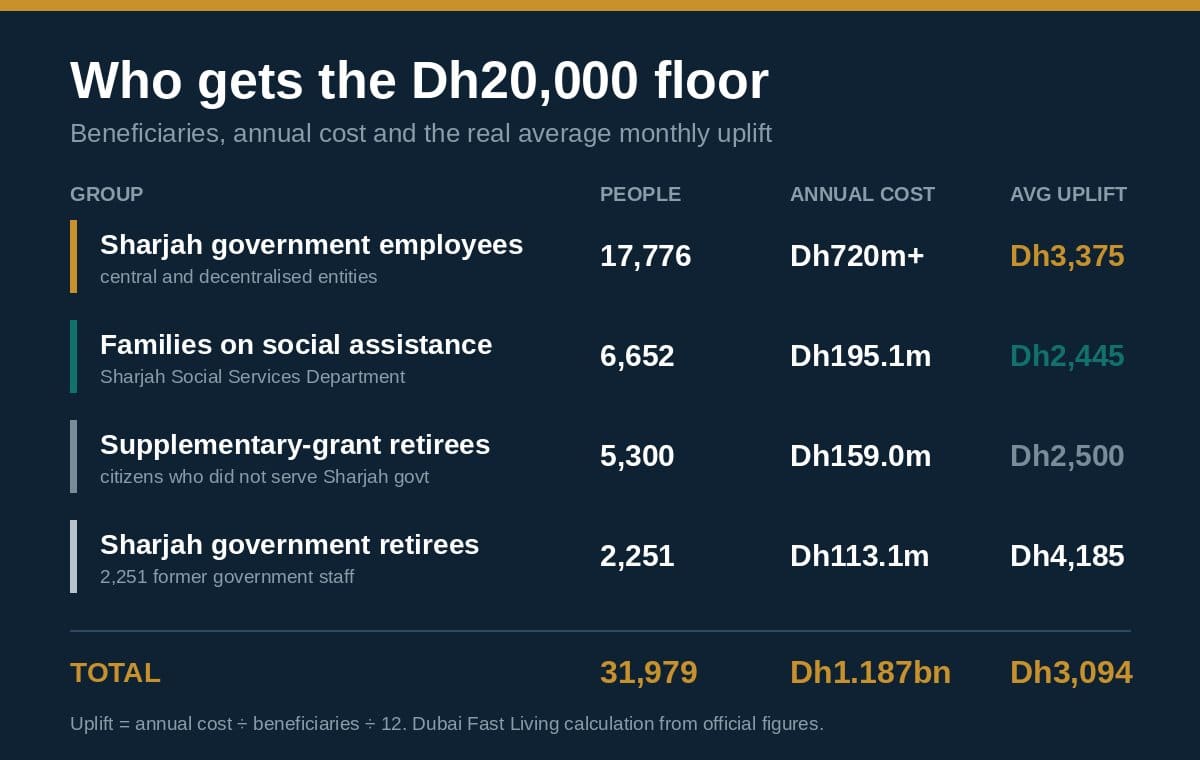
Who gets it: the four groups
Sharjah gave a separate number of people and a separate yearly cost for each group. Put them side by side and something shows up that the headline hides.
This is mostly about government pay, not welfare. Government workers are 55.6% of the people and 60.6% of the money. Families on social help — the group most people picture when they hear “social support” — are 20.8% of the people and 16.4% of the money.
| Group | People | Annual cost (AED) | Share of the bill | Average extra per month |
|---|---|---|---|---|
| Sharjah government workers all government bodies | 17,776 | 720,000,000+ | 60.6% | Dh3,375 |
| Families on social help Sharjah Social Services Department | 6,652 | 195,130,164 | 16.4% | Dh2,445 |
| Retired Sharjah government workers | 2,251 | 113,056,572 | 9.5% | Dh4,185 |
| Other retired citizens on extra grants, never worked for Sharjah government | 5,300 | 159,000,000 | 13.4% | Dh2,500 |
| Total | 31,979 | 1,187,186,736 | 100% | Dh3,094 |
The number of people and the yearly costs come from the Sharjah Department of Human Resources. The share of the bill and the average extra per month are our own sums: yearly cost ÷ number of people ÷ 12.
Where the people are, and where the money goes
Each bar adds up to 100%. Government workers take a bigger share of the money than of the people.
How Sharjah got from Dh12,000 to Dh20,000
September 2026 was not a one-off. It is the third step on a ladder, and the last two steps came only eight months apart.
Sharjah’s lowest monthly income, step by step
On 5 January 2026 the Ruler raised the Social Services Department floor to Dh17,500. That covered 4,237 cases and cost Dh404,940,624 a year. The list was made up of 3,126 older people, 877 divorced people, 134 widows and low-income households.
The same order also covered 560 job requests and 672 housing rent cases. It added free home nursing for senior citizens, and it said the money must be paid without deducting the cost of that nursing.
Now notice the jump. In January there were 4,237 social help cases. By September there were 6,652 families. Either more people became eligible, or the list simply grew.
If you get this money, here is what to check
There is no form to fill in.
The rule is applied to lists the government already has. Those are the payroll for workers, the pension register for retired people, and the Social Services Department list for families.
If you are already on one of those lists, it reaches you on its own.
What is worth doing is checking that it arrived. Also check it was worked out from the right starting figure.
- Look at your September payment, not August. The rule starts on 1 September 2026, so September is the first payment it affects.
- Do your own sum first. Dh20,000 minus what you were already getting is what you are owed. If your September figure is below Dh20,000, something is wrong, or your case sits in a different group than you think.
- Know which of the four groups you are in. Someone who retired but never worked for the Sharjah government is on the extra grant list, not the government pension list. Different route, same Dh20,000 result.
- Families on social help: check your file is up to date. The list grew from 4,237 to 6,652. If anything changed at home — a death, a divorce, someone in the family getting older — the Social Services Department record has to show it, or the sum will be wrong.
- Senior citizens: home nursing is free and separate. The January 2026 order says it must not be deducted from your monthly money. If you see nursing costs taken off, that goes against the order.
- New government joiners are on a different scale. Dh27,125 a month for university graduates, Dh20,950 for school leavers. Neither of those is the floor. Both are above it.
- There is a public way to raise a problem. The “Direct Line” programme on Sharjah Radio and Television — the same show where this was announced — is where individual citizen cases in Sharjah are regularly raised and sorted out.
Be clear about this
None of this reaches expat residents, or people who work for private companies and are not UAE citizens. The Dh20,000 rule is for Sharjah citizens in those four government lists. It is not a minimum wage for Sharjah. The UAE has no general minimum wage for private company jobs.
Where the Dh1.187 billion comes from
Sharjah publishes the answer in its own budget.
The Ruler approved Sharjah’s 2026 budget on 29 December 2025. Total spending is Dh44.5 billion, up 3% on 2025. The Dh1.187 billion for this new rule is 2.7% of that. Real money, but not the thing that decides the budget.
The interesting part is where the money comes in. Sheikh Mohammed bin Saud Al Qasimi, Chairman of the Sharjah Finance Department, published the breakdown. Three numbers stand out.
Read them together and the story is simple. Sharjah is not paying for this with oil money. Oil and gas is only 2% of what comes in. The emirate lives off its working economy instead. That means fees, charges for government services, customs duty at the ports, money from investments and land, and now tax.
That tax line doubled in one year. That is the UAE’s 9% corporate tax showing up in the emirate’s accounts. Corporate tax is a tax companies pay on their profits. It is not a tax on your salary. There is still no tax on personal income in the UAE. But businesses in Sharjah now put in a lot more than they used to. Tax has grown to about 16% of everything Sharjah takes in.
Some of the spending is also borrowed. Paying back loans and the interest on them takes 15% of the 2026 budget. That is more than the 12% spent on subsidies and aid. Sharjah says this itself in its budget announcement.
The money map: where it comes in, where it goes out
Shares as published in Sharjah’s 2026 budget. The four spending sectors add up to 100% once you include government admin, security and safety at 12%.
What the budget is spent on
| What the money is spent on | Share | Change from 2025 |
|---|---|---|
| Capital projects | 35% | maintained |
| Salaries and wages | 30% | — |
| Operating expenses | 25% | — |
| Paying back loans and interest | 15% | 1 point lower |
| Subsidies and aid | ~12% | — |
| Capital expenditure | ~2% | — |
| These are the shares exactly as Sharjah announced them. They overlap, so they add up to more than 100 — salaries and aid sit partly inside the other lines. Sharjah also splits the same budget a second way, and that one does add up to 100: roads and buildings 35%, growing the economy 30%, social spending 23%, and government admin, security and safety 12%. |
Two groups of people, one budget
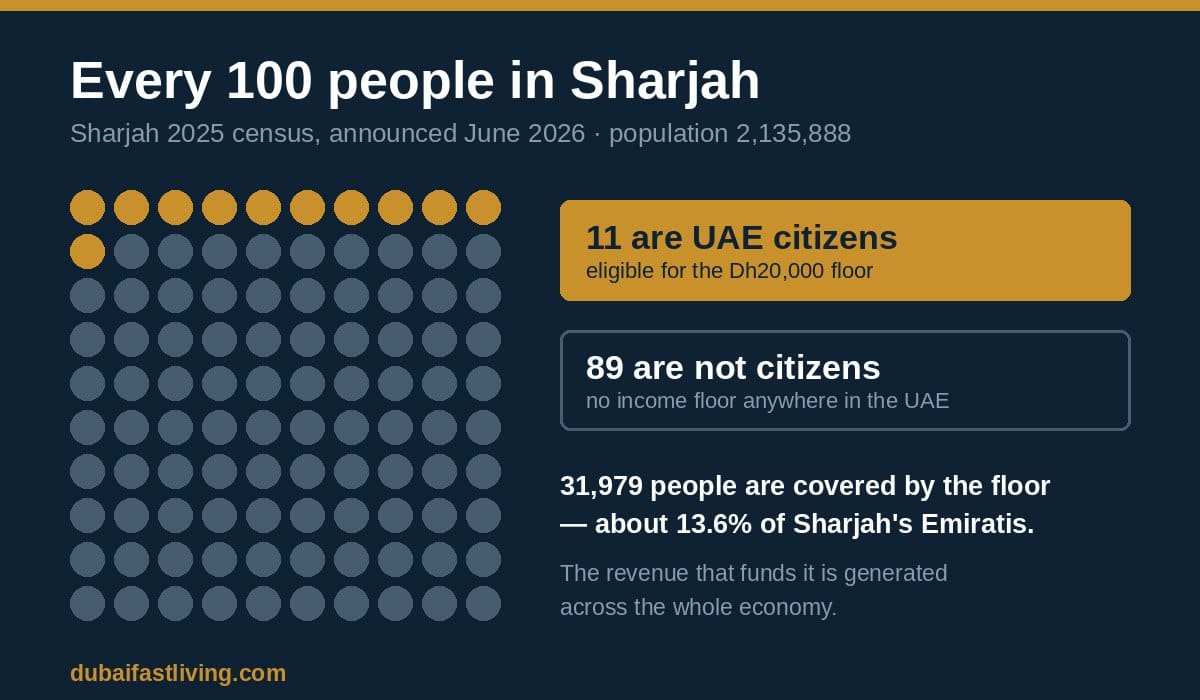
Sharjah’s 2025 census was announced in June 2026. It counted 2,135,888 people in the emirate, up 51% in ten years. Of those, 89 out of every 100 are not UAE citizens and 11 are. That is roughly 235,000 Emiratis and around 1.9 million expat residents.
Every 100 people in Sharjah
Sharjah 2025 census, announced June 2026. Gold = UAE citizens (11). Grey = everyone else (89).
Said plainly, with no spin: the Dh20,000 rule is for citizens, and citizens are 11% of the people living in Sharjah. The 31,979 people covered are about 13.6% of Sharjah’s Emiratis. The money that pays for it comes from fees, service charges, customs duty, corporate tax, and rent and utility charges. All of that is produced by the whole economy. The other 89% work, rent, shop and run businesses inside that economy.
This is not a secret or a scandal. It is how the Gulf has always worked, now written down with numbers. Being a citizen comes with a guaranteed income. Being a resident comes with the right to work in a country with almost no personal tax, but no guarantee. What is new is that Sharjah has put an exact figure on the guarantee, and an exact price tag next to it.
What the other 89% do and do not get
| Promised lowest monthly income | Dh20,000 | None |
|---|---|---|
| Minimum wage for private company jobs | None in UAE law | None in UAE law |
| Tax on your salary | Zero | Zero |
| Council and rent-contract charges | Payable | You pay, through the rent contract and the SEWA bill |
| Tax if you run a business | 9% on profit above Dh375,000 | 9% on profit above Dh375,000 |
| Can you get a Sharjah government job | Yes — 717 Emiratis were hired in one 2026 batch alone | Mostly no. Hiring citizens is the stated policy |
| Do you gain from the spending indirectly | Yes | Yes — roads and buildings are 35% of the budget, and the extra household money gets spent in local shops, schools and rent |
That last row is the one that actually reaches expat residents. Dh1.187 billion a year is extra spending money in an emirate of 2.1 million people. Nearly all of it will be spent locally. It goes on rent, food, school fees, doctors and shops. Those are mostly run and staffed by expats. The money is handed to citizens. Where it ends up is the whole economy.
Is Dh20,000 a lot?
Yes. Sharjah has not set a small number. Dh20,000 a month is more than the average pay across the UAE, and about double the middle wage. This chart is the quickest way to see it.
Monthly amounts compared, in dirhams
Salary figures are for the whole UAE, from the 2024 UAE Labour Force Survey. The rent figure comes from a private market tracker, not the government.
Two things to keep in mind when you read that chart. The pay figures cover the whole UAE. That includes a very large number of workers earning under Dh5,000 a month. So it is not a fair like-for-like comparison with an Emirati household. The rent figure comes from a private company that tracks the market. It reported average yearly rents rising from Dh45,000 to Dh60,000 between January 2025 and January 2026. Other trackers report much smaller rises. Treat the rent bar as a rough guide only.
What this changes in real life
- A permanent bottom line under about 32,000 households. This is not a bonus or a one-off gift. It is a standing rule, and it has already gone up twice in 2026.
- Government jobs become far more attractive to young Emiratis. A school leaver joining the Sharjah government starts on Dh20,950 a month. A private company will struggle to match that for a first job, and that shapes where Emirati talent goes.
- More pressure on rents in the middle of the market. Dh1.187bn spread across roughly 32,000 households means more money chasing citizen housing. Whether rents actually rise depends on how much new housing gets built. Roads and buildings are 35% of the budget partly for that reason.
- The income floor and the tax line are now tied together. A guarantee that keeps rising has to be paid for by money that keeps rising. Sharjah’s tax income doubled in the same budget year. That is what makes the guarantee affordable.
- A benchmark other emirates will be judged against. Sharjah has published an exact figure, an exact number of people and an exact cost. Nobody had that to compare against before.
These figures were correct when this was written. Sharjah has not put out one single official document covering all four groups. The numbers above come from the Department of Human Resources announcement, as reported by UAE news outlets. Every outlet gives the same figures. Where a number is our own sum rather than an announced total, we say so.
Sources
| What it proves | Source | Date |
|---|---|---|
| People counts and yearly costs for all four groups; Dh1.187bn total | Khaleej Times | 3 Sept 2026 |
| Start date, 31,900+ people, who announced it and where | Gulf Business | 3 Sept 2026 |
| Starting pay for graduates and school leavers; the shared income floor idea | Arabian Post | Sept 2026 |
| The old Dh17,500 level, 4,237 cases, Dh404,940,624, who was on the list, free home nursing | Khaleej Times; Emirates 24-7 | Jan 2026 |
| Dh44.5bn budget, income and spending shares, tax money +101%, loan costs 15% | Sharjah 24 (official emirate outlet), reporting the Sharjah Finance Department | 29 Dec 2025 |
| Population 2,135,888; 89% not citizens; where Emiratis live | Sharjah 2025 census, reported by Khaleej Times | June 2026 |
| Emirati government hiring batches and the Dh6,000 training payment | Khaleej Times | 2026 |
| UAE average Dh16,000 and median Dh10,000 monthly salary | UAE Labour Force Survey 2024, as reported | 2024 |
| Sharjah average annual rent Dh45,000 to Dh60,000 — private tracker, other trackers disagree | Market tracker | Jan 2026 |
| Share of the bill, average extra per month, budget share, income before September | Dubai Fast Living calculation from the official figures above | Sept 2026 |
These figures were correct when this was written. Sharjah has not put out one single official document covering all four groups. The numbers above come from the Department of Human Resources announcement, as reported by UAE news outlets. Every outlet gives the same figures. Where a number is our own sum rather than an announced total, we say so.