The People Who Don’t Get to Call in Sick
Our Small Tribute to Healthcare WorkersThe Ones Who Stand Strong, No Matter What Happens… We have been watching the news closely these past few weeks. Like most people living in this region, we have felt the weight of uncertainty settle into the daily rhythm — the extra check of the phone, the conve

Our Small Tribute to Healthcare Workers The Ones Who Stand Strong, No Matter What Happens…
We have been watching the news closely these past few weeks. Like most people living in this region, we have felt the weight of uncertainty settle into the daily rhythm — the extra check of the phone, the conversations that trail off into silence, the quiet recalibration of what actually matters.
And what keeps coming back to us, every single time, is this: while the rest of us process and worry and wait, one group of people simply gets up and goes to work. No pause. No exit option. No version of ‘let’s see how this develops before we decide.’
Healthcare workers in the UAE don’t get that luxury. They never have. This piece is our acknowledgement of that — and our attempt to say, clearly and on record, that we see it.
When the World Fractures, Healthcare Is the Last Thing Standing
The global data on what happens to healthcare during periods of crisis is not comfortable reading.
- In 2023, 2,562 incidents of violence against healthcare workers were recorded across 30 countries (a 25% increase on the previous year, and the highest figure since monitoring began). 480 healthcare workers were killed in conflict zones that same year; nearly double the figure from the year before.
“These are not statistics about systems failing. They are statistics about human beings showing up to work in conditions where showing up carries a price most of us will never be asked to pay.”
- In northern Gaza, a senior midwife named Aydadelivered babies in hospital hallways under direct fire, using mobile phones for light when the power failed. She was killed in an airstrike shortly after, along with 37 members of her family. She had kept working until she couldn’t.
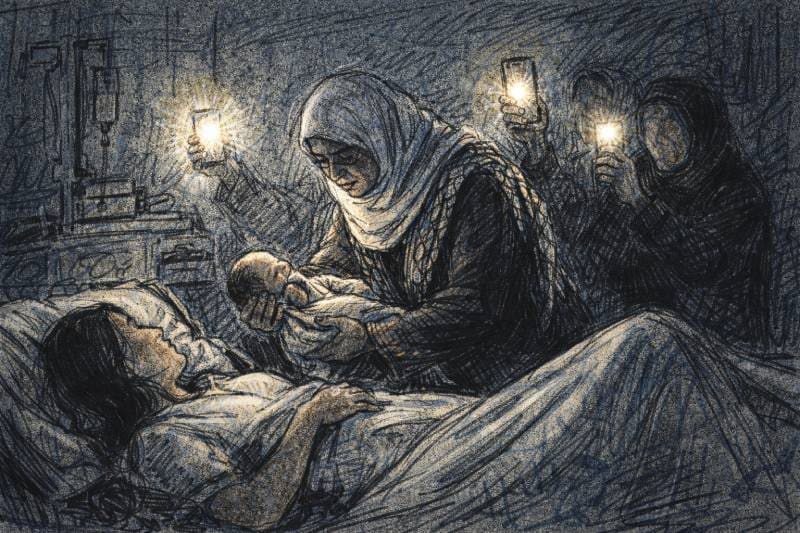
That is the standard this profession holds itself to. Not because anyone mandated it. Because the people who choose it understand that from the start.
- In Ukraine’s early conflict period, 120 healthcare facilities were damaged.
- In the Tigray region of Ethiopia, 80% of hospitals were destroyed outright.
- In Syria, where over 90% of medications were locally produced before the civil war, surgeons now operate under torchlight and nurses warm intravenous fluids with their own body heat. Life expectancy there has fallen by nearly two decades.
That is what a healthcare system looks like when it breaks — and it is the clearest possible argument for what it means when one holds.
The UAE System Was Built for This Moment
The UAE is not a conflict zone.
But it has never had the luxury of pretending it lives in an uncomplicated neighbourhood. That geographic reality shapes everything about how its healthcare infrastructure is designed, funded, and stress-tested.
The UAE Department of Health was conducting emergency drills for large-scale calamities years before COVID-19 arrived.
“The system that residents depend on today was not assembled in response to a crisis. It was built in anticipation of one — and that distinction matters enormously.”
When COVID-19 arrived as the real test, the preparation held. The Dubai Health Authority restructured its 12 primary healthcare centres within weeks, converting facilities into dedicated fever clinics to redirect suspected cases away from general care settings. The UAE administered over 10.5 million vaccine doses, achieving the second-highest per-capita vaccination rate in the world at the time.
“Behind every one of those numbers was a person — masked, exhausted, absorbing the collective anxiety of four million residents — who came back the next morning anyway.”
Studies conducted during the pandemic found high levels of depression, anxiety, insomnia, and acute distress among UAE healthcare workers, with nurses and female staff most severely affected. They felt it. They carried it. They did not stop.
That is not institutional efficiency. That is individual human character, at scale, sustained over months.
The Workforce That Deserves to Be Named
82% of physicians and 96% of nurses working in the UAE hold non-UAE passports. Indian doctors. Filipino nurses. British consultants. Egyptian specialists. South Asian technicians, pharmacists, and support staff whose names appear on no press release and whose shifts end long after the rest of the city has gone to sleep.
This workforce is not here by accident. They are here because they chose to be — on contracts, far from their own families, in a country that is not their passport home, serving a population that is overwhelmingly expatriate itself.
“The covenant is not national duty. It is something more deliberate: a professional commitment made with full knowledge of what it costs.”
The surgeon at Cleveland Clinic Abu Dhabi reviewing scans at midnight. The nurse at Rashid Hospital who has not been home in two years. The pharmacist in Deira explaining a dosage to a frightened patient in three languages. The lab technician who processes 200 samples before 7am and whose contribution to public health is invisible precisely because it works.
These are not supporting characters in Dubai’s story. They are load-bearing walls.
Like a well-run kitchen that never announces itself to the dining room, the best sign that the UAE’s healthcare system is working is that most residents are never aware of the effort behind it.
The seamlessness is the achievement.
What the Region Teaches Us About What We Have
Living in this part of the world sharpens your perspective in ways that living elsewhere does not.
Regional uncertainty is not an abstract concept here — it is a weather pattern. It moves in, it intensifies, it eventually shifts.
“What determines whether a society comes through it intact is not geography or luck. It is the strength of the institutions that continue functioning while everything else holds its breath.”
Healthcare is the institution that holds the deepest.
When families feel uncertainty, they do not think first about financial markets or supply chains or diplomatic statements. They think about whether, if something happens, someone will be there. That reassurance — quiet, reliable, and almost entirely taken for granted — is what the UAE’s healthcare workforce delivers every single day.
We are, as a region, living through a moment that asks hard questions of every system and every institution. Healthcare does not get to defer its answer. It has to show up and provide one in real time, every shift, with whatever it has.
The UAE’s healthcare workers are doing exactly that. They were doing it before this moment of uncertainty arrived, and they will be doing it long after it passes.
The investment behind them is real — healthcare spending in the UAE is projected to exceed $30 billion annually by 2027— but investment is infrastructure. The people operating inside it are something the budget cannot fully account for.
We Say This on Record
Gratitude expressed privately changes nothing. We are saying this here, in print, because the people this piece is about deserve more than a passing acknowledgement.
“To every doctor, nurse, pharmacist, technician, paramedic, and support worker operating within the UAE’s healthcare system right now: we see the weight of what you carry. We know you don’t get to pause and process the news before your shift. We know the anxiety you absorb from patients and their families does not clock out when you do.”
We are residents of a city and a region that is fortunate — genuinely fortunate — to have a healthcare system that functions, and a workforce that makes that function feel like a given. It is not a given. It is a choice, made daily, by people who understood what they were signing up for and showed up anyway.
That deserves to be said. We are glad to say it.
A note before we end: This piece focuses on the UAE, because this is where we are and what we know. But our hearts are with every healthcare worker across this region right now — in the countries absorbing the heaviest weight of uncertainty, in the hospitals operating under conditions most of us cannot imagine, in the clinics held together by people working with whatever they have. Iran, Lebanon, Yemen, Gaza and beyond — the healthcare workers there are carrying something far heavier than what we describe here. They deserve recognition that no editorial can adequately provide. We acknowledge them, we respect them, and we do not forget that they exist in the same conversation.
Data sources