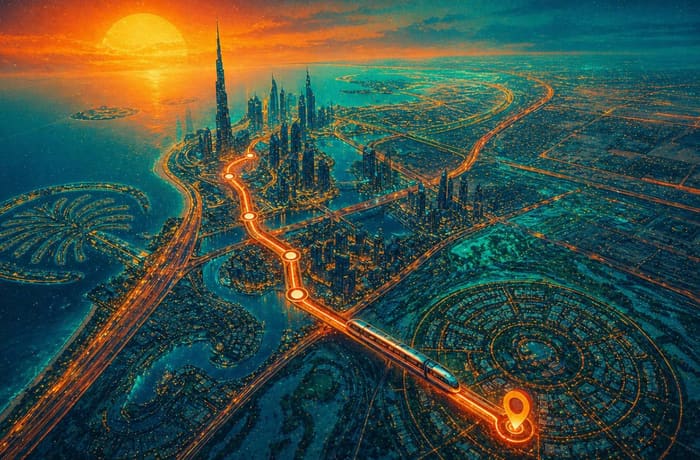
The Hessa Street Multiplier: How the 4-Minute Commute is Redefining Yields in JVC and Arjan
TL;DR: On 19 April 2026, the RTA opened the Hessa Street Development Project, slashing travel time from 15 minutes to 4 (full story here). For investors in JVC, Arjan, and Al Barsha South, this is a fundamental recalibration of “location value” likely to trigger higher occupancy and a 6–12 month lag

TL;DR: On 19 April 2026, the RTA opened the Hessa Street Development Project, slashing travel time from 15 minutes to 4 (full story here). For investors in JVC, Arjan, and Al Barsha South, this is a fundamental recalibration of “location value” likely to trigger higher occupancy and a 6–12 month lagged price appreciation.
The Infrastructure-to-Price Chain
Dubai’s property market runs on one fuel above all others: access.
Shorten the commute and you widen the tenant pool. ↳ Widen the tenant pool and rents firm up. ↳Rents firm up and sale prices follow.
That chain: infrastructure → access → demand → price … has played out in this city three times in living memory.
It is playing out again now.
The RTA has just doubled Hessa Street’s capacity from 8,000 to 16,000 vehicles per hour and cut travel time between Sheikh Zayed Road and Al Khail Road from 15 minutes to four.
Eight Communities in the Access Zone
The RTA confirms these areas are directly served by the project. By 2030, the population here is projected to exceed 640,000.
| Community | Character | Current Avg Price (AED/sqft) |
|---|---|---|
| Jumeirah Village Circle | Mid-market apartments, high tenant demand | ~850 |
| Arjan | Entry-level, high yield, direct on corridor | ~650–700 |
| Al Barsha South | High-volume investment market | ~700–800 |
| Dubai Science Park | Mixed residential-commercial | ~700–800 |
| Jumeirah Lakes Towers | Established, metro-connected | ~1,100–1,300 |
| Barsha Heights | Office-residential hybrid | ~900–1,000 |
| Jumeirah Islands | Villa community | ~1,400–1,600 |
| Emirates Hills | Ultra-luxury villas | ~2,000+ |
Price data: Valorisimo, GuestReady, MN Vision — 2025/2026 market averages
The Million Dirham Question: Does Infrastructure Move Prices?
Yes.
Here is the evidence from Dubai itself.
- Case 1 — Red Line Metro: 26.7% appreciation for properties within a 15-minute walk.
- Case 2 — Route 2020: Al Furjan villa prices rose 42.5% year-on-year post-opening.
- Case 3 — Blue Line (2023-2025): Dubai Silicon Oasis led the city with +29% growth on the announcement alone.
Case 1 — The Red Line Metro (2009–2022)
When Dubai’s Red Line opened in September 2009, the market was sceptical. A rail system in a car city felt like a novelty. The data, tracked over 12 years, told a different story.
Rise in property prices
The CBRE Dubai Metro Report 2023, cited by Economy Middle East, found that: ✳️ Properties within a 15-minute walk of Red Line stations appreciated 26.7% on average between Q1 2010 and Q4 2022, outpacing Dubai’s wider market growth of 24.1%. ✳️ Properties in the 10–15 minute walk zone grew 43.8% over the same period.
Rise in rentals
✳️ During the same 2018–2022 window, rents near Red Line stations rose 5.7% while Dubai’s average rents fell 4.1% — a 9.8 percentage point divergence. ✳️ JBR recorded 40.5% price growth. Dubai Marina: 35.9%.
Case 2 — Route 2020 / Al Furjan Metro Station (2021)
The Route 2020 extension opened in January 2021, adding seven stations and connecting Al Furjan, Discovery Gardens and Jumeirah Golf Estates to the Red Line.
Knight Frank, cited by Khaleej Times, published specific walk-zone data that went further than CBRE’s averages:
Rise in property prices
✳️ Properties within five minutes of a Metro station: +51% (2010–2018) ✳️ Properties within 10 minutes: +58% Properties within 15 minutes: +33%
Al Furjan’s villa prices subsequently rose 42.5% year-on-year post-opening, with studio yields reaching 8.75%, per Januss Developers’ 2025 market data (janussdevelopers.com).
Occupancy rates in Al Furjan buildings near the station now exceed 85%, per Bayut and Dubizzle trends compiled by Map Homes Real Estate.
Case 3 — The Blue Line Announcement Effect (2023–2025)
The Blue Line was announced in November 2023. It does not open until September 2029. Yet the market moved on the announcement alone — and moved hard.
Rise in property prices
Per Bayut’s 2025 year-end report via Gulf News: ✳️ Dubai Silicon Oasis led all Dubai communities in apartment price growth: +29% per square foot within 12 months of the announcement.
Rise in rentals
Betterhomes data via Property Monitor, reported by DXB Properties, tracked rent changes in Blue Line corridor communities since November 2023:
| Community | Studio Rent Before | Studio Rent After | Change |
|---|---|---|---|
| Academic City | AED 42,000/yr | AED 60,000/yr | +43% |
| Dubai Silicon Oasis | — | — | +28% |
| International City | — | — | +22% |
| Blue Line corridor avg | — | — | +23% |
Infrastructure did this before a single track was laid.
The pattern is consistent, documented and specifically Dubai.
Why Hessa Street is Different
A metro announcement triggers anticipation-driven pricing.
Hessa Street is different: the road is already open.
- There is no announcement premium to capture.
- Investors who moved on the news have already moved.
What remains is the practical, lived effect — and that plays out in two stages.
Stage 1 (months 1–9): Vacancy tightens. Tenants who previously avoided JVC and Arjan due to the commute now factor in a 4-minute run to Sheikh Zayed Road. Landlords are anticipated to face fewer empty weeks between tenancies.
Stage 2 (months 9–24): Firmer rents at renewal. Landlords in areas with tightened vacancy have leverage at the renewal table they did not have before. Sale prices follow rent moves, typically with a 6–12 month lag.
Road upgrades historically generate quieter responses than metro connectivity.
Rail attracts car-free tenants. Rroads improve the experience for those already there. Both move prices. Roads move them more slowly and more steadily.
Community-Level Impact Assessment
Arjan
Highest Direct Benefit
Arjan sits directly on the corridor. Sheikh Zayed Road access was specifically one of the four junctions upgraded in the project. If any community gains the most from this week’s upgrade, Arjan is the candidate.
The numbers justify the attention.
- Average apartment prices in Arjan stand at approximately AED 266,000 (around AED 650–700/sqft), making it one of the most affordable entry points in Dubai, per GuestReady’s 2026 yield analysis (guestready.com).
- Gross yields range between 6.4% and 7.9%, with an average of approximately 7.9% on some data cuts.
- Al Barsha South Fourth — which borders Arjan — recorded 10,469 transactions in the first half of 2025 alone, topping Dubai’s DLD charts for that period, per Mieyar UAE data.
The tenant profile here is the mid-income professional or family that was previously making a pragmatic trade-off: cheap rent in exchange for a stressful commute. The Hessa Street upgrade directly recalibrates that trade-off.
The commute friction that suppressed Arjan’s appeal relative to its price point is now removed.
JVC
Yield Story Gets Sharper
JVC is already one of Dubai’s most scrutinised mid-market investments.
- Gross yields run between 7% and 9% for apartments in 2026.
- Average sale prices sit around AED 850 per square foot — roughly 40–45% below Dubai Marina.
- Studios in well-maintained buildings occasionally touch 10%.
- JVC was also among the top locations by residential sales transaction volume in Dubai in 2025, according to Cavendish Maxwell data cited in the Global Property Guide’s UAE market analysis (globalpropertyguide.com).
Immediate pros of this upgrade: The persistent weakness was always westward access. Getting onto Sheikh Zayed Road during morning peak was exactly the kind of daily irritation that pushed comparison shoppers toward JLT or Barsha Heights, even at a rental premium. That argument is now weaker.
Wait and watch:The countervailing force is supply. Roughly 120,000 new residential units were projected for handover across Dubai in 2026. Some of that lands in JVC. Yield compression is a real risk in a high-supply environment. The road upgrade does not override supply, it improves JVC’s relative positioning within a crowded market.
Landlords with properties on the Hessa-facing side of JVC hold the best hand.
Al Barsha South
Quiet Volume Play
Al Barsha South does not attract the same attention as JVC or Arjan, but the transaction data tells a different story.
- Al Barsha South Fourth led Dubai’s entire market by transaction volume in H1 2025. That volume reflects deep investor and end-user appetite at this price point — and the Hessa Street corridor runs directly through it.
- The upgrade improves east-west movement for Al Barsha South residents who commute toward Dubai Marina, JLT, or Internet City.
- For developers with projects here, faster access to Sheikh Zayed Road is a tangible differentiator in marketing materials. Expect to see it used as one.
The Hessa street upgrade adds a tangible commute argument for the east-west professional tenant base this market depends on.
JLT
Reinforced, Not Transformed
JLT already has metro and Sheikh Zayed Road access.
Yields are 5.1%–7.2% per GuestReady — a more established, lower-upside profile.
The upgrade smooths the eastbound commute route for JLT residents heading to Downtown or the airport. A supporting positive, not a game-changer.
Emirates Hills
No Material Change
The buyer profile here does not make commute decisions based on road upgrades.
Pricing will not move on this news.
Phase 2: The Next Catalyst
The RTA has awarded the contract for Phase 2 (3km extension to MBZ Road). This includes 8,835m of new bridges and a 480m tunnel. Once finished, travel times on that stretch will drop from 24 minutes to five.
For Arjan and Al Barsha South, this places them in a “Golden Corridor” between two major upgrades.
[Phase 2 completion date not yet confirmed by RTA. Verify before factoring into any investment timeline.]
Three Signals Worth Watching
- Vacancy data in JVC and Arjan over Q3–Q4 2026. Vacancy tightens before rents move. That sequence typically runs six to nine months post-infrastructure completion.
- Off-plan launches on the corridor. Developers price access improvements into new project marketing immediately. New Arjan and Al Barsha South launches that cite the Hessa upgrade are the first visible market response — and they confirm developer confidence in the repricing thesis.
- Rental renewal terms, Q3 2026 onwards. Landlords who previously offered concessions to retain tenants now have a concrete access argument. Whether they use it depends on supply conditions — but the argument exists where it did not before.
Infrastructure data: RTA official statements and Dubai Media Office, as reported by Gulf News, Khaleej Times and The National, 19–20 April 2026. Yield and price data: Valorisimo, GuestReady, MN Vision. Precedent data: CBRE Dubai Metro Report 2023 via Economy Middle East; Knight Frank via Khaleej Times; Betterhomes/Property Monitor via DXB Properties; Bayut 2025 year-end via Gulf News.