Family Loses Gold Worth AED 50,000; Dubai Police Recovers in 3 Days
In a city often described as one of the safest in the world, a recent incident has once again reinforced that reputation. A family accidentally threw away gold worth AED 50,000, only to have it traced and returned within three days — thanks to a waste-collection worker’s honesty and Dubai Police’s s

In a city often described as one of the safest in the world, a recent incident has once again reinforced that reputation.
A family accidentally threw away gold worth AED 50,000, only to have it traced and returned within three days — thanks to a waste-collection worker’s honesty and Dubai Police’s swift coordination.
The Accident

Kamini Kannan had lived in the UAE for 23 years before returning to India in 2021. Recently, she travelled back to Dubai to attend a wedding. While preparing for the event, she checked her old gold pouch and realised it was torn. To be safe, she transferred her valuables into a temporary pouch and left it on the dining table.
Inside the pouch were four 22-carat gold coins weighing 8 grams each, along with a 50-gram 24-carat gold bar.
The next day, while cleaning the house, her son Abhimanyu mistook the pouch for trash and threw it away. By the time the family realised what had happened, the garbage had already been collected.
Years of savings had disappeared in minutes.
They informed building security but privately assumed the gold would never be recovered.
The Unexpected Call
Three days later, Abhimanyu received a phone call asking whether he had lost something valuable.
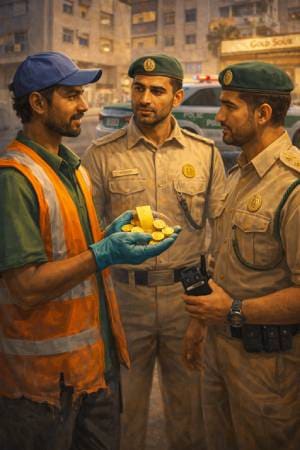
The call was from Dubai Police.
A waste-collection worker had discovered the pouch while handling trash. After noticing gold inside, he chose not to keep it. Instead, he reported the find through the formal system at the Gold Souk, where recovered gold items can be handed over to authorities.
From there, the process began.
How the Gold Was Traced
Police questioned the worker, who confirmed he had found the pouch in the garbage. Officers then examined waste-collection records to identify the specific route and building linked to that trash batch.
With help from building management and security, they were able to trace it back to the family.
Abhimanyu was asked to visit Naif Police Station, where officers showed him the recovered gold. To claim it, he provided photographs, purchase bills, and proof of ownership. The gold was returned.
More Than Just a Recovery
At its core, the story reflects two things: personal integrity and institutional structure.
The waste worker could have easily kept the gold. Instead, he reported it. But honesty alone is not enough without a system that supports it. Clear reporting channels, recorded waste routes, coordination between departments, and verification procedures allowed the case to be resolved in just three days.
For Kamini, who had spent over two decades in the UAE, the incident reaffirmed something she had long experienced — that laws are enforced, systems are documented, and accountability is real.
Why Stories Like This Stand Out
Dubai consistently ranks among the safest cities globally in major safety indexes.
“The UAE records low levels of violent crime, strong public trust in law enforcement, and high ratings for personal security. Strict regulations, surveillance infrastructure, and swift policing contribute to this environment.”
It is not common anywhere in the world to accidentally throw away gold worth AED 50,000 and receive a call from the police days later asking you to collect it.
Yet in Dubai, the combination of individual honesty and structured governance makes such outcomes possible.
This was not just about lost gold. It was about a city where systems function, records are traceable, and integrity still plays a role in everyday life.