Dubai Home Prices Decline for the First Time Since Pandemic: Which Buyers Should Worry
No investor wants to read first thing in the morning about Dubai home prices decline. But it has unfortunately, happened. Dubai’s famous property boom has just blinked. A 5.9% monthly drop has rattled the market. But beneath the headline is a split reality: established homeowners are largely fine, w
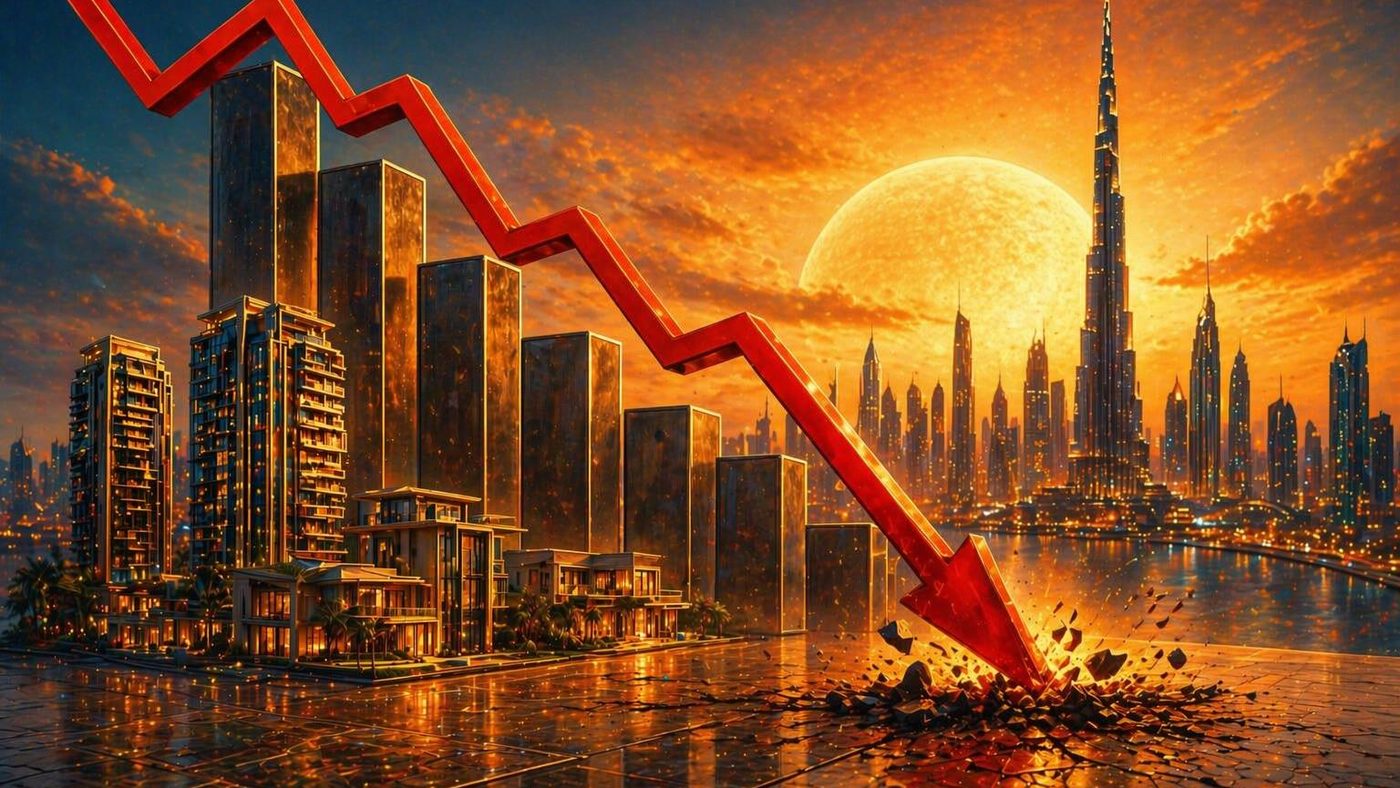
No investor wants to read first thing in the morning about Dubai home prices decline. But it has unfortunately, happened.
Dubai’s famous property boom has just blinked.
A 5.9% monthly drop has rattled the market. But beneath the headline is a split reality: established homeowners are largely fine, while off-plan buyers in high-supply corridors are sitting on a live wire.
For the first time since the Covid-era crash of 2020, home valuations in the emirate have fallen — and the question every investor, expat homeowner, and prospective buyer is now asking is the same: is this a wobble, or the beginning of something far more serious?
The answer, as you’ll see below, depends entirely on where you own and why you bought.
Dubai Home Prices Decline: What the Data Says
The ValuStrat price index, the benchmark used by several of the UAE’s largest banks, recorded a 5.9% fall in March 2026 compared with February. That is the first confirmed decline since 2020, when Covid shut global markets down entirely.
Even with the drop, the index is only back to where it stood six months ago. Think of it as a lift that descended two floors after climbing twenty.
−5.9%
ValuStrat index, March vs Feb First drop since 2020
−20%
Residential sales value AED 37.2bn in March
~13K
Transactions in March Down from ~16K in February
+70%
Price rise since 2020 The rally now being tested
What is ValuStrat?
ValuStrat is a Dubai-based property research and valuation consultancy whose price index is built from actual valuations, not listed prices or developer figures. Several UAE banks use its data for loan underwriting decisions. Which means the market takes this number seriously.
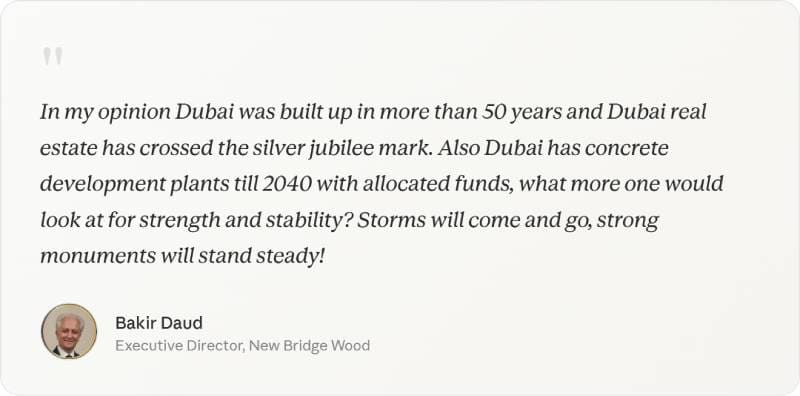
Industry reacts: Mr. Bakir Daud, Executive Director, New Bridge Wood Properties comments:
Three Forces Hit at Once
March 2026 is the first month these three pressures converged simultaneously. Separating them is essential for understanding what is structural and what is temporary.
| Force | Type | Risk level |
|---|---|---|
| Iran-US-Israel regional conflict; missiles struck UAE soil for the first time | Structural | High |
| Eid Al-Fitr holiday reduced working days and transaction windows | Seasonal | Medium |
| Heavy UAE rainfall disrupted site visits and signings | Seasonal | Medium |
| Supply pipeline of 200,000–300,000 units due by 2028 entering delivery phase | Structural | Medium |
The geopolitical shock is the dominant factor. Dubai built its entire post-2020 proposition on the idea that it is the region’s safe address — a city where global capital lands and stays. Missiles on UAE soil rewrite that psychological contract in ways no press release fully repairs.
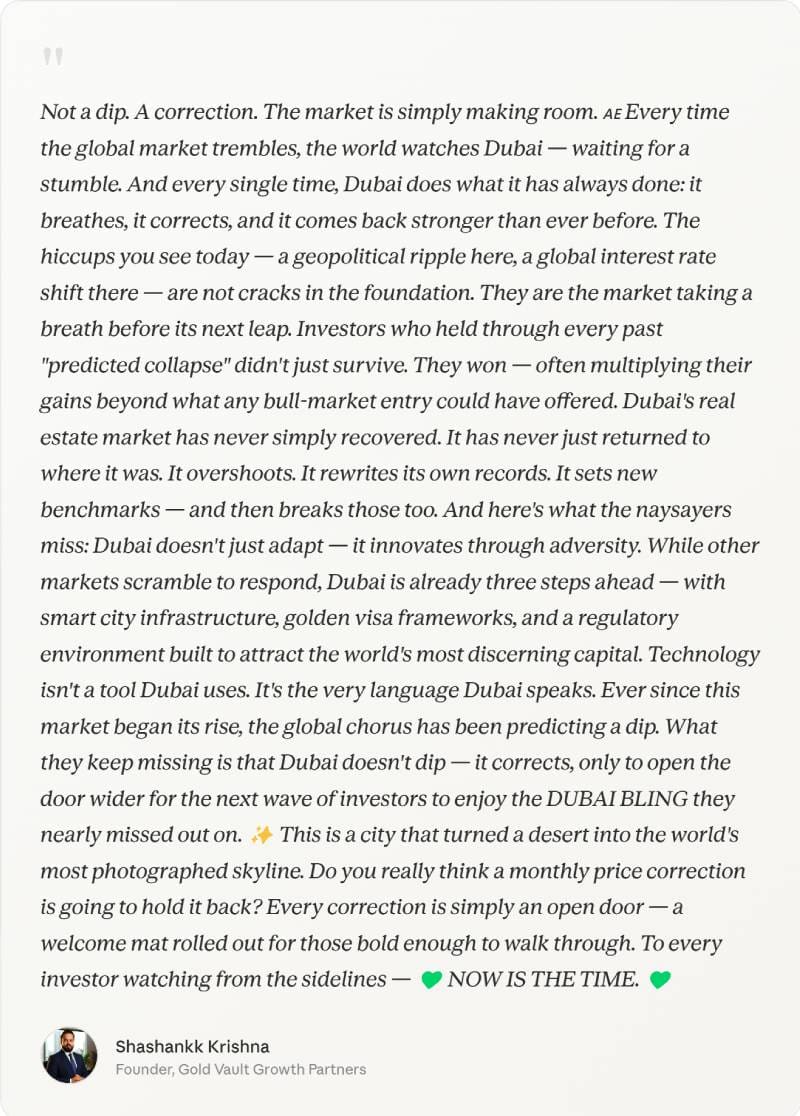
Industry reacts: Mr. Shashankk Krishna, Founder of Gold Vault Growth Partners, comments:
The Split Market: The Angle Others Are Missing
Every outlet reporting on this decline is treating Dubai as one market. It is, in reality, two — and they are heading in opposite directions.
Gulf Business reported that once land transactions are stripped out, March’s residential deal value came in at AED 34.03 billion — which is actually 1% higher than March of the previous year. The overall headline number looks bad precisely because land deals collapsed. The lived residential market held steadier than the top-line figure suggests.
Under pressure
- Off-plan units in Jumeirah Village Circle and Al Furjan: Strong supply pipelines, weak rental absorption
- Projects priced above AED 2,500 per sqft: Speculative buyers banking on pre-handover exits
- Suburban off-plan launches where foreign demand drove 65–70% of sales activity in 2025
Holding firm
- Established villa communities: Palm Jumeirah, Jumeirah Islands, The Meadows — with constrained supply and deep end-user demand
- Prime ready homes in Downtown and Business Bay where land is limited
- Properties held by Golden Visa buyers with long-term residency anchoring their ownership decision
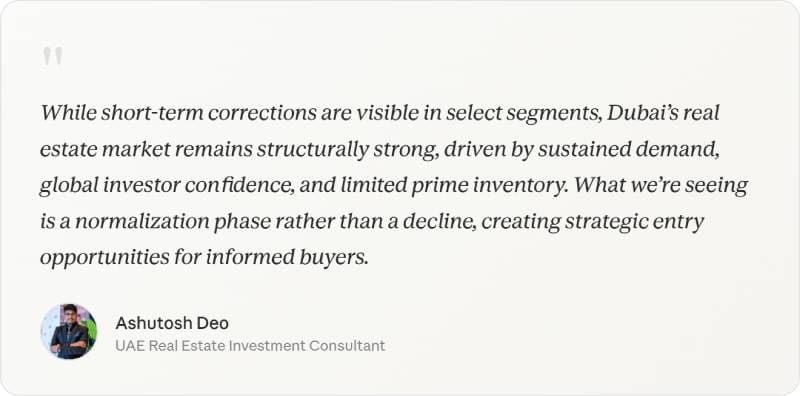
Industry reacts: Mr. Ashutosh Deo, UAE Real Estate Investment Consultant, comments:
The Six-Year Boom That Created This Moment
To grasp why a single month of declining valuations is significant, you need to understand how long the run was that preceded it.
| Column 1 | Column 2 |
|---|---|
| Dubai’s citywide residential values stood at AED 1,689 per sqft in December 2025 | ↑↑ Up 19.8% year-on-year, according to ValuStrat |
| Full-year 2024 saw 180,900 transactions worth AED 522.1 billion | ↑↑ A 36% volume increase and 27% value rise year-on-year, per Dubai Land Department data |
| The UAE attracted a record 9,800 millionaires who relocated in 2025 | ↑↑ The highest inflow of any country globally |
Moreover, Golden Visa property buyers accounted for 35–40% of recent off-plan transaction value, per Dubai Land Department figures
The boom was real, it was demand-driven, and it had structural legs. That is precisely what makes the current inflection point worth watching carefully rather than dismissing.
The Golden Visa (a 10-year renewable UAE residency available to property investors who purchase AED 2 million or above) turned a transaction market into a settlement market.
Buyers were no longer flipping — they were moving families.
That shift is the single biggest reason analysts do not expect a 2009-style collapse.
What happened in 2009?
Dubai’s property market came close to default in 2009 after an off-plan bubble burst.
Developers had pre-sold thousands of units before construction began, demand evaporated, and prices fell by roughly 50% in some areas within 18 months.
The government had to restructure major developer debts. That episode is the reference point every analyst reaches for, and the key reason today’s data is being scrutinised so closely.
The Off-Plan Trap: Why This Specific Segment Deserves Its Own Warning
Off-plan sales, where buyers purchase units before construction finishes, made up 65% of all Dubai transactions in 2025.
That concentration is the structural vulnerability hiding inside the headline numbers.
| Segment | Risk profile | Reason |
|---|---|---|
| Off-plan suburban (JVC, Al Furjan) | High | Heavy delivery pipeline; rental demand lags new supply |
| Off-plan above AED 2,500/sqft | High | Buyers intended to exit near handover; sentiment shock freezes that strategy |
| Off-plan mid-range, AED 2–5m segment | Medium | Demand surged 25% in Q1 2026, but conflict introduces exit uncertainty |
| Ready homes, established communities | Low | End-user demand, 6–8% rental yields reduce seller pressure |
The 2009 parallel sits exactly here.
An off-plan-heavy market with sustained foreign demand is resilient, until foreign demand pauses.
Knight Frank estimates 331,000 homes are due for completion between 2026 and 2030. Those units need buyers. The geopolitical uncertainty is arriving precisely as that supply wave builds.
What Still Holds the Floor – Why Prices Won’t Fall
The structural supports underneath Dubai property are genuine and worth stating plainly. This is not a market running on sentiment alone.
Demand anchors
- Dubai’s population is above 4 million; government targets 5.8–7.8 million by 2040.
- Around 50,000–60,000 new residents arrive annually, each needing housing.
- Prime rental yields of 6–8% keep owners from distressed selling.
- Zero income tax remains a hard-to-replicate advantage over London, Singapore, and New York.
Policy floor
- Real Estate Strategy 2033 targets AED 1 trillion in total market value and doubled GDP contribution from the sector.
- Golden Visa programme continues to drive 35–40% of off-plan deal value.
- Developer balance sheets are healthy. No forced discounting expected from major players.
- DFM real estate stock index fell ~21% after the conflict; actual home prices move far more slowly.
What You Should Do Right Now, If You Have Invested in Dubai Real Estate
The right response to this data is neither panic nor indifference. It depends entirely on your position.
| Your situation | Recommended action |
|---|---|
| Ready-home buyer with end-use intent (family relocation, Golden Visa) | Stronger negotiating position than at any point since 2022. Motivated sellers exist in high-supply areas. Proceed with due diligence on rental yield, not just capital appreciation. |
| Off-plan investor within 12 months of handover | Audit your exit assumptions against today’s rental yields, not 2024 price comparables. Understand whether your project sits in a high-supply corridor before deciding whether to hold or flip. |
| Landlord with lease renewals in the next 60–90 days | Tenants know the market has softened and will use it as leverage. Get ahead of renewals early — a small concession on rent now costs less than a vacant unit in a cooling market. |
| Long-term established community owner (Palm, Dubai Hills, Meadows) | Your fundamentals are intact. Monitor the geopolitical situation but resist the urge to sell into a temporarily sentiment-driven dip. The 206% post-pandemic gain does not vanish in a single month. |
Sources: Bloomberg (23 April 2026) · ValuStrat · REIDIN · Gulf Business · Knight Frank · Dubai Land Department · Top Luxury Property · BusinessToday
Comments from real estate advisors awaited