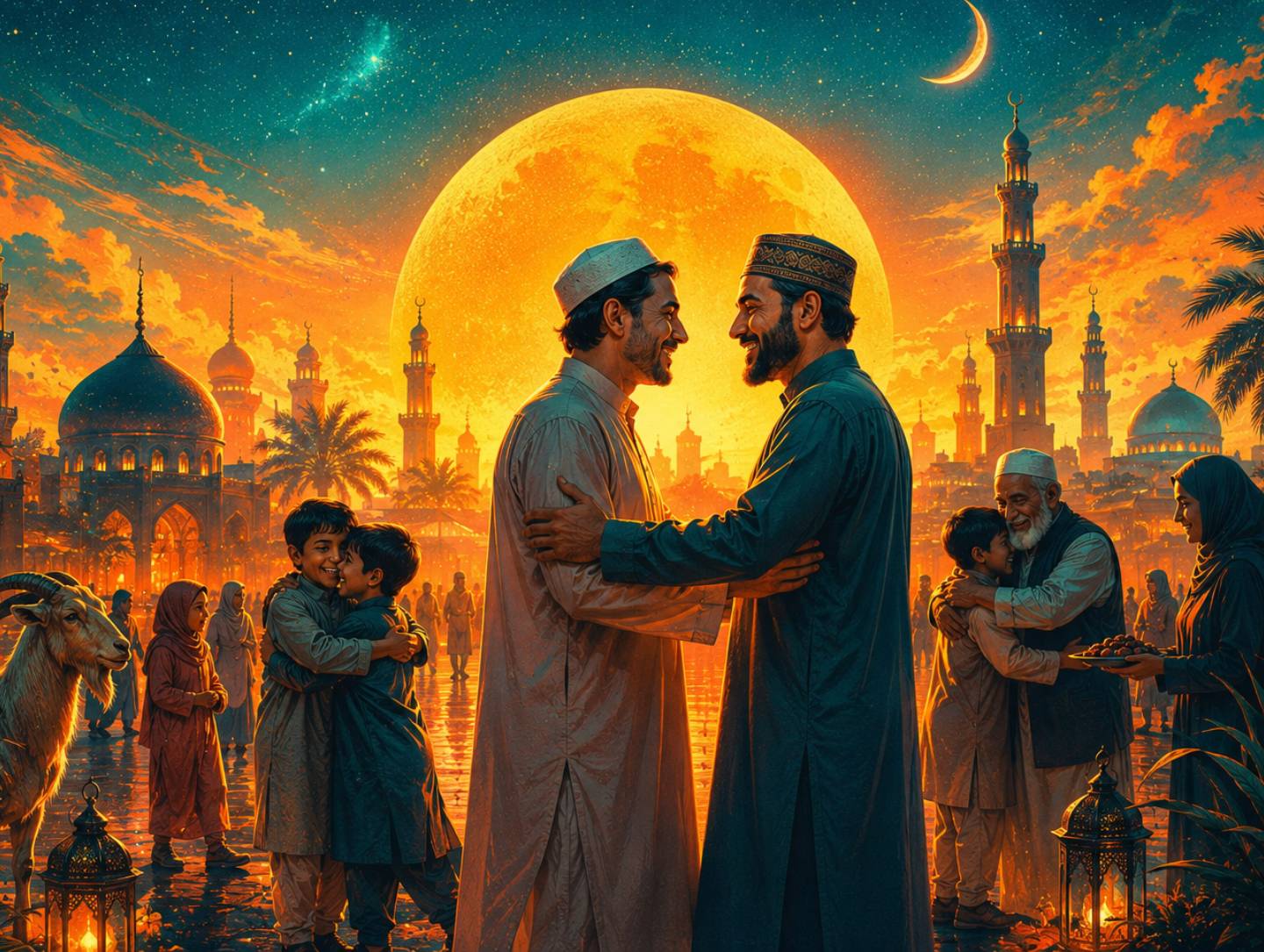
The standard way to greet someone during Eid Al Adha in the UAE is “Eid Mubarak” (pronounced Eed Moo-BAH-rak), meaning “blessed Eid.” The proper reply is “Khair Mubarak” or simply echoing “Eid Mubarak” back.
Emiratis often add “Taqabbal Allah minna wa minkum” (may Allah accept it from us and you) or “Kul ‘am wa antum bikhair” (may every year find you in good health) for elders and senior contacts.
Non-Muslims are warmly welcome to say Eid Mubarak in the UAE — it is considered a respectful, friendly gesture across the country’s multicultural society.
How to Greet Eid Al Adha in UAE: The Core Phrases
In the UAE, the universal greeting for Eid Al Adha is “Eid Mubarak”. The phrase is Arabic and translates literally to “blessed festival” or “blessed Eid.”
You will hear it used across every nationality, language and social context in the country — from Emirati majlis gatherings to Filipino office WhatsApp groups, from Pakistani family dinners to British expat compounds. If you only learn one phrase, learn this one.
Two extensions add depth depending on who you are greeting. “Eid Saeed” means “happy Eid” and is the more casual choice for social messaging.
“Kul ‘am wa antum bikhair” translates to “may every year find you in good health” and is the formal, traditional Gulf phrasing — the version Emiratis use with elders, bosses and clients.
The Eid Al Adha 2026 pillar guide covers the religious significance of the holiday itself, while this guide focuses purely on how to greet people.
How to Pronounce Eid Mubarak Correctly
The most common mispronunciation is “Aid Mubarak” with an “ay” sound — this is incorrect. The opening syllable is always a long “ee.”
The Arabic letter behind it (ع) has no exact English equivalent, but “Eed” is the closest natural approximation any English speaker can use without sounding off. Emiratis and Arabic speakers will instantly understand and respond warmly.
Choose Your Context: How to Greet for Eid Al Adha
The right greeting depends on who you are speaking to. Tap a context below to see exactly what to say, how formal to be, and what to expect in reply.
👔 Greeting your boss or managerFormal
Say: “Eid Mubarak. Wishing you and your family a blessed Eid Al Adha.”
Optional formal layer: “Kul ‘am wa antum bikhair” — if your manager is Emirati or Arab, this earns serious respect points.
Channel: face-to-face if possible, otherwise a short email or WhatsApp on the morning of Eid Day 1 (Wed 27 May 2026).
Avoid: emojis, slang or anything overly casual. Keep it warm but professional.
🤝 Greeting a client or business contactFormal
Say: “Eid Mubarak. We hope you and your team enjoy a peaceful Eid Al Adha with loved ones.”
Channel: a brief email to the contact (not a marketing blast), ideally on the morning of Eid Day 1.
Tone: warm, sincere, no pitch. Avoid attaching commercial offers, since that defeats the goodwill.
For Gulf-based clients: add “Taqabbal Allah minna wa minkum” if you are comfortable — it shows you understand Gulf business etiquette.
💻 Greeting a Muslim coworkerFriendly
Say: “Eid Mubarak! Have a lovely break with the family.”
Channel: Teams, Slack or WhatsApp on the last working day before Eid, or in person.
If you want to go further: “Eid Saeed” works too — slightly more casual.
Avoid: assuming all Muslims observe identically. Some travel, some host family, some keep it quiet. A simple “Eid Mubarak” covers everyone.
👪 Greeting an Emirati family or elderTraditional
Say: “Eid Mubarak. Kul ‘am wa antum bikhair.” (May every year find you in good health.)
Add for elders: “Asakum min ‘awadah” — a beautiful Gulf phrase meaning “may you be among those who return to celebrate this again.”
Religious option: “Taqabbal Allah minna wa minkum” — literally “may Allah accept from us and from you.”
Body language: a soft handshake (men to men, women to women), or a hand-to-heart gesture if unsure. Avoid hugging or kissing across genders unless already family-close.
🚕 Greeting your driver, nanny or helperPersonal
Say: “Eid Mubarak! Thank you for everything — have a wonderful break.”
Cultural note: if your driver, nanny or helper is Muslim, this matters to them, since many work far from family during Eid. A small Eid bonus (Eidi) or sweet gift is a long-standing UAE tradition.
If they are Filipino, Hindu or Christian: “Eid Mubarak” is still appropriate as a recognition of the UAE’s shared holiday. Many will respond warmly even if they do not observe.
Channel: in person at the start of the Eid break, with eye contact and a genuine smile.
🌍 Greeting as a non-Muslim or touristWelcomed
Say: “Eid Mubarak!”
Is it respectful? Yes, completely. The UAE has one of the most multicultural Eid cultures in the Muslim world, and non-Muslims saying Eid Mubarak is welcomed and appreciated as a sign of respect, never as appropriation.
When: from the evening before Eid Day 1 through the end of the holiday (Tuesday 26 May evening through Friday 29 May 2026).
What you will usually hear back: a smile and either “Eid Mubarak” or “Khair Mubarak.”
How to Reply to “Eid Mubarak” Properly
If someone greets you with “Eid Mubarak,” you have four standard responses, each correct in different contexts.
The rule of thumb is to match the energy and formality of the person greeting you.
If your Emirati neighbour says “Eid Mubarak, kul ‘am wa antum bikhair,” replying with just “Eid Mubarak” is fine, but adding “wa antum bikhair” (and you in good health) back is a graceful touch.
If a colleague sends a casual “Eid Saeed” on Slack, a smiley emoji and “Eid Saeed!” is perfectly judged.
What Emiratis Actually Say During Eid Al Adha
If you spend Eid in an Emirati majlis (gathering), you will hear a layered set of greetings that go beyond “Eid Mubarak.” The most authentic Gulf phrases are set out below.
Cultural context on Emirati greetings is widely documented by the General Authority of Islamic Affairs and Endowments (Awqaf UAE), the federal body that oversees mosques, fatwas and Islamic guidance in the country.
Eid Al Adha Workplace Etiquette in UAE
UAE offices are some of the most multicultural workplaces in the world. A typical Dubai team might include Emirati, Indian, Pakistani, Filipino, Egyptian, British and American colleagues. Eid Al Adha workplace etiquette balances religious respect with multicultural inclusivity.
For client emails sent during the Eid window, a brief “Eid Mubarak” line above your normal signature is appropriate. Avoid commercial pitches in greeting emails, since that converts goodwill into spam.
The What’s open guide shows which government and business services are closed if you need to plan your client follow-ups.
Can Non-Muslims Say Eid Mubarak? (Yes — and Here’s Why)
This is one of the most-asked questions in the UAE every Eid: is it respectful for non-Muslims to say Eid Mubarak?
The answer is yes, warmly so. In the UAE’s deeply multicultural society, Eid Mubarak functions like “Merry Christmas” or “Happy Diwali” in other parts of the world: a friendly recognition of someone else’s celebration, never appropriation.
The phrase carries no exclusive religious gatekeeping. It simply means “blessed Eid.”
If you are a Hindu, Christian, Buddhist, Jewish, agnostic or atheist resident or visitor, saying Eid Mubarak to a Muslim colleague, neighbour, driver or shopkeeper is universally welcomed. It signals you recognise their celebration and respect their culture — exactly the everyday gesture that makes UAE life work so smoothly across faiths.
More on Eid Al Adha 2026 in the UAE
Frequently Asked Questions: How to Greet Eid Al Adha in UAE
What do you say for Eid Al-Adha in UAE?
The standard greeting is “Eid Mubarak,” Arabic for “blessed Eid.” It is universally understood and used by every nationality in the UAE during Eid Al Adha 2026. More formal alternatives include “Kul ‘am wa antum bikhair” (may every year find you in good health) for elders and senior contacts, and “Taqabbal Allah minna wa minkum” (may Allah accept from us and you) for practising Muslims. “Eid Saeed” is a lighter, more casual variant.
How do you pronounce Eid Mubarak correctly?
Eid Mubarak is pronounced “Eed Moo-BAH-rak.” The opening syllable rhymes with “feed,” not “eyed.” The stress in “Mubarak” sits on the middle syllable (BAH), and the final “k” is soft, almost trailing. The most common Western mispronunciation is “Aid Mubarak” with an “ay” sound — this is incorrect. Arabic speakers and Emiratis will understand any reasonable approximation, so say it warmly with eye contact.
What should I reply to Eid Mubarak?
There are four correct replies. The simplest is to echo back “Eid Mubarak” — always correct, friendly and universal. “Khair Mubarak” (blessed goodness to you too) is the traditional Arabic response. “Taqabbal Allah minna wa minkum” is the religious option used between practising Muslims. “Asakum min ‘awadah” is the beautiful Gulf-specific phrase meaning “may you be among those who return.” Match the formality of the person greeting you.
Can non-Muslims say Eid Mubarak in UAE?
Yes — completely. In the UAE’s multicultural society, non-Muslims saying “Eid Mubarak” is warmly welcomed and considered respectful, much like wishing someone Merry Christmas or Happy Diwali in other contexts. It signals recognition of someone else’s celebration and is one of the everyday gestures that makes UAE life work smoothly across faiths. The only guidance is to say it within the Eid window (25 to 29 May 2026 for Eid Al Adha), not weeks before or after.
How do Emiratis greet each other during Eid Al Adha?
Emiratis layer greetings beyond “Eid Mubarak.” The most traditional Gulf phrase is “Kul ‘am wa antum bikhair” (may every year find you in good health), used with elders and respected contacts. “Asakum min ‘awadah” (may you be among those who return) is a uniquely Gulf greeting. After Eid prayers, “Taqabbal Allah minna wa minkum” is common. Body language matters too — a soft handshake among same-gender greetings, with hand-to-heart gestures across genders unless already family-close.
What is the best Eid greeting for a boss or client in UAE?
For a boss or business client, use the formal phrasing: “Eid Mubarak. Wishing you and your family a blessed Eid Al Adha.” For Emirati or Arab managers and clients, adding “Kul ‘am wa antum bikhair” earns serious respect — it shows you understand Gulf etiquette. Send it via email or WhatsApp on the morning of Eid Day 1 (Wednesday 27 May 2026), keep it warm but professional, avoid emojis or slang, and never attach a commercial pitch to a greeting message.
Is “Eid Mubarak” enough in UAE, or should I say more?
“Eid Mubarak” alone is perfectly enough in 95% of UAE situations — it is the universal greeting understood by every nationality. Layering more depends on context. With elders, in-laws, Emirati family or senior business contacts, adding “Kul ‘am wa antum bikhair” makes it more respectful. With practising Muslim friends after Eid prayers, “Taqabbal Allah minna wa minkum” carries religious depth. With casual coworkers or on social media, “Eid Saeed” is the lighter, friendlier option.
When do you say Eid Mubarak — the day before or during Eid Al Adha 2026?
The polite window for Eid Mubarak during Eid Al Adha 2026 in UAE is from the evening of Monday 25 May (after sunset prayer following moon sighting confirmation) through to Friday 29 May, the third and final day of Eid. The morning of Eid Day 1 — Wednesday 27 May 2026 — is the peak greeting moment, particularly after Eid prayers. Saying it on Arafat Day (Tuesday 26 May) is acceptable. Saying it more than two days before or after the window is unusual.

Leave a Reply